
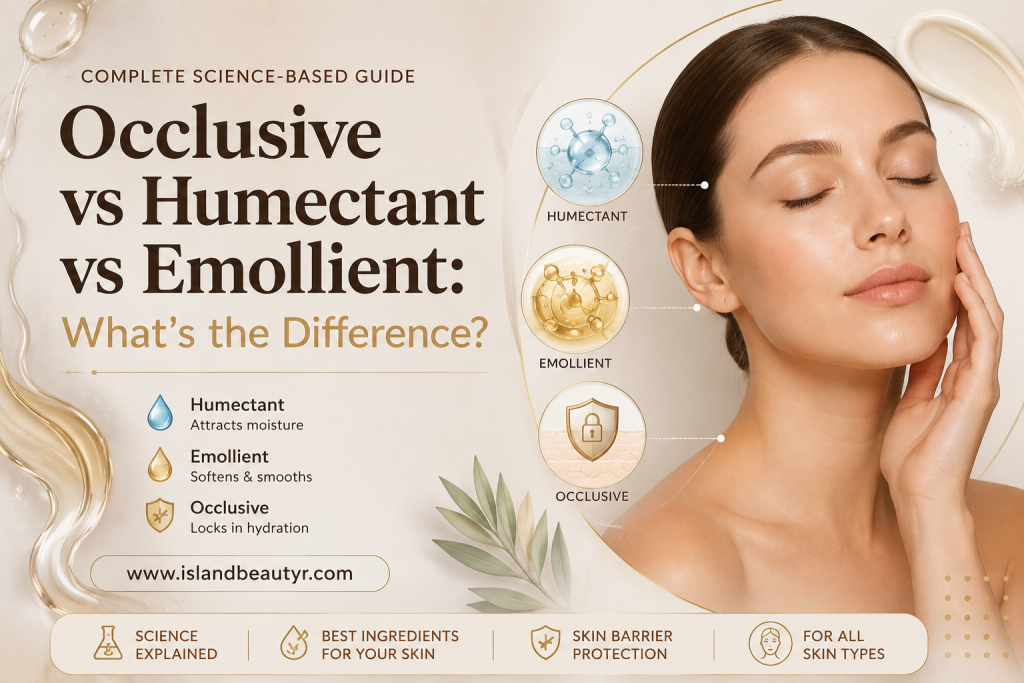
Occlusive vs Humectant vs Emollient: What’s the Difference?
Have you ever looked at the ingredient list of a moisturizer and wondered why some products contain glycerin, others rely on petrolatum, while many feature shea butter, ceramides, or squalane? Although all these ingredients help keep your skin hydrated, they don’t work in the same way.
Understanding the difference between occlusives, humectants, and emollients is one of the most important steps toward building an effective skincare routine. Choosing the wrong moisturizer for your skin type may leave your skin feeling greasy, dehydrated, or even worsen irritation and breakouts.
Dermatologists classify moisturizing ingredients into these three functional groups because each supports the skin barrier through a different biological mechanism. Some ingredients attract water, some prevent water from escaping, while others smooth rough skin by filling microscopic gaps between skin cells.
In this comprehensive guide, you’ll learn the scientific differences between occlusive vs humectant vs emollient, understand when each category performs best, discover which ingredients belong to each group, and learn how combining all three can dramatically improve skin hydration and barrier repair.
This is islandbeautyr.com, and I am Rasta Kafashan, the author of this website. I can help you better understand and become more aware of your skin, based on the most up-to-date scientific research. So, stay with us and follow islandbeautyr.com.
Why Moisturizers Work Differently
Many people assume that every moisturizer hydrates the skin in the same way. In reality, hydration involves several biological processes occurring within the outermost layer of the skin, known as the stratum corneum.
Healthy skin naturally contains:
- Water
- Natural Moisturizing Factors (NMF)
- Ceramides
- Cholesterol
- Free fatty acids
- Sebum
Together, these components maintain the skin barrier and reduce Transepidermal Water Loss (TEWL).
When this barrier becomes damaged by excessive cleansing, harsh weather, retinoids, exfoliating acids, or aging, water escapes more rapidly. This leads to dryness, irritation, redness, tightness, and increased skin sensitivity.
Different moisturizer ingredients solve different parts of this problem.
Some attract moisture.
Some trap moisture.
Others repair the skin surface.
This is exactly where the concepts of humectants, emollients, and occlusives become important.
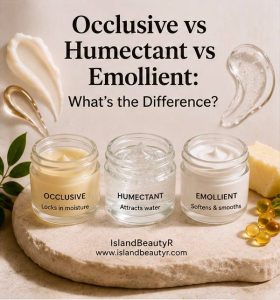
What Is a Humectant?
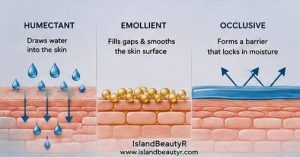
Humectants are ingredients that attract water molecules like tiny magnets.
They increase hydration by drawing water either from deeper skin layers or from the surrounding environment into the outer layer of the skin.
Think of a humectant as a sponge.
It absorbs water and holds it within the skin.
Common humectants include:
- Glycerin
- Hyaluronic Acid
- Sodium PCA
- Panthenol
- Aloe Vera
- Urea
- Betaine
- Honey
- Sorbitol
- Propylene Glycol
Benefits of Humectants
- Increase skin hydration
- Improve skin elasticity
- Reduce roughness
- Support barrier recovery
- Reduce visible dehydration lines
- Improve product absorption
Potential Drawbacks
In extremely dry climates with low humidity, humectants may pull water from deeper layers of the skin instead of the air if they aren’t combined with occlusive ingredients. This may leave the skin feeling even drier over time.
For this reason, dermatologists usually recommend layering humectants underneath an occlusive moisturizer.
What Is an Emollient?
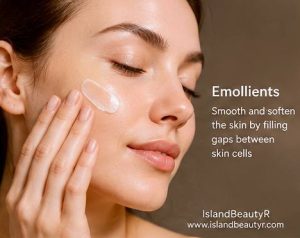
Unlike humectants, emollients do not primarily attract water.
Instead, they soften and smooth the skin by filling tiny cracks between skin cells.
Imagine the skin surface as a brick wall.
The skin cells are the bricks.
The spaces between them are filled with lipids.
When these lipids become depleted, the surface becomes rough and uneven.
Emollients replace these missing lipids, making the skin feel softer and smoother.
Common emollients include:
- Squalane
- Ceramides
- Shea Butter
- Fatty Alcohols
- Jojoba Oil
- Sunflower Oil
- Coconut Oil
- Dimethicone
- Cholesterol
Benefits of Emollients
- Smooth rough texture
- Restore skin flexibility
- Repair barrier function
- Improve comfort
- Reduce flaking
- Strengthen damaged skin
Unlike occlusives, most emollients feel lighter and are more cosmetically elegant.
What Is an Occlusive?
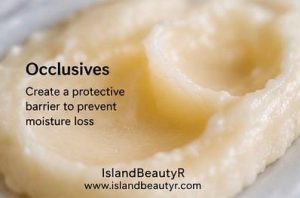
Occlusives create a protective barrier on top of the skin.
Instead of adding water, they reduce water loss.
Their primary role is preventing evaporation.
Studies show that petrolatum can reduce transepidermal water loss by approximately 98%, making it one of the most effective occlusive ingredients available.
Common occlusives include:
- Petrolatum
- Mineral Oil
- Beeswax
- Lanolin
- Dimethicone
- Paraffin
- Castor Oil
Benefits
- Prevent moisture loss
- Protect damaged skin
- Speed barrier recovery
- Reduce irritation
- Protect against cold weather
- Lock in previous skincare products
People with eczema or severely damaged skin often benefit from moisturizers rich in occlusive ingredients, especially when applied immediately after bathing.
Occlusive vs Humectant vs Emollient: Side-by-Side Comparison
Although all three ingredient categories improve skin hydration, the science behind Occlusive vs Humectant vs Emollient reveals that each one works through a completely different biological mechanism. Understanding Occlusive vs Humectant vs Emollient makes it much easier to choose products that match your skin type and repair your skin barrier effectively.
| Feature | Humectant | Emollient | Occlusive |
|---|---|---|---|
| Primary Function | Attracts water | Smooths skin | Prevents water loss |
| Works On | Skin Hydration | Skin Texture | Skin barrier |
| Best For | Dehydrated skin | Rough skin | Very dry skin |
| Skin Feel | Lightweight | Silky | Rich |
| Risk | May need sealing | Rarely irritating | Can feel greasy |
| Common Ingredients | Glycerin, Hyaluronic Acid | Ceramides, Squalane | Petrolatum, Beeswax |
When comparing Occlusive vs Humectant vs Emollient, it becomes clear that these ingredients are not competitors. Instead, they complement one another and work best when combined in a well-formulated moisturizer.
Which Is Best for Your Skin Type?
Choosing between Occlusive vs Humectant vs Emollient depends largely on your skin’s needs rather than your skin type alone.
Dry Skin
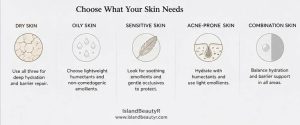
Dry skin lacks both water and protective lipids. The ideal moisturizer should include all three ingredient groups.
Recommended combination:
- Humectants to attract water
- Emollients to restore softness
- Occlusives to lock hydration inside the skin
This combination provides the most complete solution when comparing Occlusive vs Humectant vs Emollient for dry skin.
Oily Skin
Many people with oily skin mistakenly avoid moisturizers.
However, oily skin can still become dehydrated.
The best approach is to choose lightweight humectants and non-comedogenic emollients while minimizing heavy occlusives.
Best ingredients include:
- Glycerin
- Panthenol
- Sodium PCA
- Lightweight Squalane
- Ceramides
Combination Skin
Combination skin usually requires balance.
Light humectants hydrate oily areas without clogging pores, while moderate emollients maintain comfort on dry zones.
A heavy occlusive is usually unnecessary unless the skin barrier is damaged.
Sensitive Skin
Sensitive skin benefits from formulas containing barrier-repair ingredients.
Ideal choices include:
- Ceramides
- Cholesterol
- Panthenol
- Colloidal Oatmeal
- Petrolatum (when irritation is severe)
When evaluating Occlusive vs Humectant vs Emollient, people with sensitive skin often achieve the best results from products that contain all three categories in balanced proportions.
Acne-Prone Skin
Many acne sufferers avoid moisturizers completely.
This often makes acne worse because dehydration stimulates additional oil production.
Choose products containing:
- Glycerin
- Hyaluronic Acid
- Ceramides
- Squalane
Avoid very heavy occlusives unless specifically recommended by a dermatologist.
Can You Use Humectants, Emollients and Occlusives Together?
Absolutely.
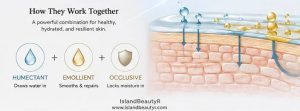
In fact, the most effective moisturizers combine all three ingredient categories.
A typical sequence looks like this:
- Humectants draw water into the skin.
- Emollients repair rough and damaged areas.
- Occlusives seal hydration and reduce water loss.
This layered approach explains why modern moisturizers outperform products that rely on only one ingredient category.
When discussing Occlusive vs Humectant vs Emollient, dermatologists emphasize that synergy—not choosing a single winner—is the key to long-lasting hydration.
Common Myths About Occlusive vs Humectant vs Emollient
Myth 1: Oily skin doesn’t need moisturizer.
False.
Oily skin can still lose water and develop dehydration.
Myth 2: Petrolatum clogs pores.
Research shows petrolatum is generally non-comedogenic when used appropriately and is one of the most effective occlusive ingredients for preventing water loss.
Myth 3: Hyaluronic Acid alone is enough.
Not always.
Without an emollient or occlusive, hydration can evaporate quickly, especially in dry environments.
Myth 4: Natural oils replace every moisturizer.
Natural oils mainly function as emollients or mild occlusives.
Most do not provide the same hydration benefits as humectants.
Dermatologist Tips
To get the most from Occlusive vs. humectant vs. emollient, dermatologists often recommend these habits:
- Apply moisturizer within three minutes after cleansing.
- Layer humectant-rich serums beneath creams.
- Use occlusive products at night if your barrier is compromised.
- Look for ceramide-based moisturizers for long-term barrier repair.
- Adjust your moisturizer with the seasons—lighter in humid weather and richer in winter.
Best Ingredient Examples
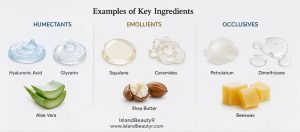
Powerful Humectants
- Glycerin
- Hyaluronic Acid
- Panthenol
- Sodium PCA
- Urea
Excellent Emollients
- Ceramides
- Squalane
- Shea Butter
- Cholesterol
- Fatty Alcohols
Strong Occlusives
- Petrolatum
- Mineral Oil
- Beeswax
- Dimethicone
- Lanolin
Why Modern Moisturizers Combine All Three
If you examine the ingredient list of many dermatologist-recommended moisturizers, you’ll notice they rarely rely on just one type of moisturizing ingredient.
Instead, they combine humectants for hydration, emollients for barrier repair, and occlusives for moisture retention.
This balanced formulation provides longer-lasting hydration, improved skin texture, and stronger protection against transepidermal water loss.
Ultimately, the discussion around Occlusive vs Humectant vs Emollient isn’t about finding a single “best” ingredient. It’s about understanding how each category contributes to healthier, more resilient skin and choosing products that deliver the right combination for your skin’s unique needs.
How to Build the Perfect Moisturizing Routine
After understanding Occlusive vs Humectant vs Emollient, the next step is learning how to use these ingredients together. The order of application can significantly improve hydration, strengthen the skin barrier, and reduce transepidermal water loss.
A simple dermatologist-inspired routine looks like this:
Morning Routine
- Gentle Cleanser
- Humectant Serum (Hyaluronic Acid or Glycerin)
- Ceramide-Based Moisturizer
- Sunscreen SPF 30+
This routine helps attract water, reinforce the barrier, and protect the skin throughout the day without feeling heavy.
Evening Routine
- Gentle Cleanser
- Hydrating Serum
- Barrier-Repair Moisturizer
- Occlusive Layer (only if skin is very dry or compromised)
Nighttime is when the skin naturally repairs itself, making it the ideal time to use richer moisturizers containing occlusive ingredients.
Ingredient Labels: How to Identify Humectants, Emollients, and Occlusives
One of the easiest ways to understand occlusives vs. humectants vs. emollients is by reading the ingredient list on skincare products.
Look for These Humectants
- Glycerin
- Hyaluronic Acid
- Sodium PCA
- Panthenol
- Urea
- Aloe Barbadensis Leaf Juice
- Betaine
Look for These Emollients
- Ceramide NP
- Ceramide AP
- Ceramide EOP
- Squalane
- Shea Butter
- Caprylic/Capric Triglyceride
- Cholesterol
- Fatty Alcohols
Look for These Occlusives
- Petrolatum
- Mineral Oil
- Paraffin
- Dimethicone
- Lanolin
- Beeswax
If you notice ingredients from all three categories in one product, there’s a good chance it offers balanced hydration and barrier support.
Choosing the Right Moisturizer by Season
Many people use the same moisturizer year-round, but your skin’s needs change with the environment.
Winter
Cold temperatures and indoor heating increase transepidermal water loss. Moisturizers containing occlusives, ceramides, and rich emollients help prevent dehydration.
Summer
Hot and humid weather usually calls for lighter formulations. Gel creams with glycerin, hyaluronic acid, panthenol, and lightweight emollients often provide enough hydration without feeling greasy.
Dry Climate
If you live in an area with low humidity, pair humectants with occlusives. Humectants alone may not provide long-lasting hydration in these conditions.
Common Mistakes When Using Moisturizers
Even the best ingredients won’t perform well if used incorrectly.
Avoid these common mistakes:
- Applying moisturizer to completely dry skin.
- Using only a hyaluronic acid serum without sealing it with a moisturizer.
- Choosing heavy occlusives for oily, acne-prone skin without considering formulation.
- Skipping moisturizer because your skin feels oily.
- Over-exfoliating and expecting moisturizer alone to repair a damaged skin barrier.
Correct application is just as important as selecting the right ingredients.
Frequently Asked Questions About Occlusive vs Humectant vs Emollient
What is the main difference between Occlusive vs Humectant vs Emollient?
Humectants attract water into the skin, emollients smooth and repair the skin surface, while occlusives create a protective layer that reduces water loss. Understanding Occlusive vs Humectant vs Emollient helps you choose products that address your skin’s specific needs.
Which is better: humectant, emollient, or occlusive?
There isn’t a single winner in the Occlusive vs Humectant vs Emollient comparison. Each ingredient category performs a unique function, and most dermatologists recommend products that combine all three.
Is hyaluronic acid a humectant?
Yes. Hyaluronic acid is one of the most well-known humectants because it binds water and improves skin hydration. For optimal results, it should be paired with emollients and occlusives.
Is petrolatum bad for acne?
Petrolatum is considered non-comedogenic for most people and is highly effective at reducing transepidermal water loss. However, individuals with very oily skin may prefer lighter formulations.
Can oily skin use occlusive ingredients?
Yes, but the formulation matters. Lightweight occlusives such as dimethicone are often more suitable than heavier ointments for oily or acne-prone skin.
Are ceramides humectants?
No. Ceramides are classified as emollients and barrier-repair lipids. They strengthen the skin barrier and reduce water loss over time.
Can I use hyaluronic acid without a moisturizer?
You can, but it is generally not recommended. Pairing a humectant with an emollient or occlusive helps lock in hydration and improves long-term results.
Which moisturizer ingredients are best for a damaged skin barrier?
Dermatologists often recommend a combination of glycerin, ceramides, cholesterol, fatty acids, and petrolatum because they hydrate, repair, and protect the skin simultaneously.
Final Verdict: Occlusive vs Humectant vs Emollient
When comparing Occlusive vs Humectant vs Emollient, it becomes clear that there is no universal winner. Each ingredient category addresses a different aspect of skin hydration and barrier health.
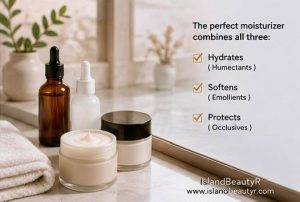
Humectants replenish water, emollients restore smoothness and flexibility, and occlusives prevent moisture from escaping. Together, they create a complete moisturizing strategy that supports healthier, stronger, and more resilient skin.
Rather than choosing one over another, the most effective approach is to select moisturizers that combine these ingredients in balanced formulations tailored to your skin type, climate, and skincare goals. Understanding Occlusive vs Humectant vs Emollient empowers you to make informed decisions, avoid common skincare mistakes, and build a routine backed by dermatological science.