
9 Powerful Signs Your Skin Barrier Is Healing: Science-Backed Guide
If your skin has recently become dry, tight, flaky, red, or unusually sensitive, you may be wondering whether your skincare routine is actually helping. The good news is that your skin often gives you clues when things are moving in the right direction. Knowing the signs your skin barrier is healing can make it much easier to recognize real progress.
A damaged skin barrier can make even a simple skincare routine feel difficult. Your moisturizer may sting, your face may feel tight after cleansing, and products that you previously tolerated can suddenly seem irritating. As the barrier recovers, these reactions often begin to change.
The important thing is that skin barrier healing is rarely an overnight transformation. Your skin may improve gradually, with small changes appearing before you notice a dramatic difference in the mirror.
In this guide, we will look at the most useful signs your skin barrier is healing, explain why they happen, and discuss how to support your skin while it recovers.
This is islandbeautyr.com, and I am Rasta Kafashan, the author of this website. I can help you better understand and become more aware of your skin, based on the most up-to-date scientific research. So, stay with us and follow islandbeautyr.com.
What Is the Skin Barrier?
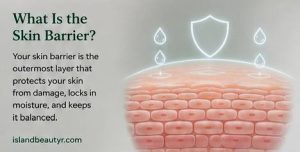
Before discussing the signs, your skin barrier is healing, it helps to understand what the skin barrier actually does.
The skin barrier is a complex protective system located primarily in the outer layers of the skin. The stratum corneum, the outermost layer of the epidermis, plays a particularly important role.
It contains corneocytes surrounded by an organized lipid matrix that includes ceramides, cholesterol, and fatty acids. Together, these components help control water movement through the skin and protect against external stressors.
One important measure of barrier function is transepidermal water loss (TEWL). TEWL describes the movement of water through the skin into the surrounding environment. When the barrier is impaired, water loss can increase, contributing to dryness and dehydration.
This is why a damaged barrier can cause several symptoms at once. Your skin may feel dry but also become oily in some areas. It may feel tight yet produce breakouts. It may look rough while simultaneously becoming much more sensitive.
During skin barrier recovery, these symptoms can gradually become less intense.
9 Signs Your Skin Barrier Is Healing:
1. Your Skin Feels Less Tight After Cleansing
One of the earliest signs your skin barrier is healing is often something you feel rather than see.
If your skin barrier has been irritated, you may notice that your face feels tight immediately after washing. Your cheeks might feel stretched, or you may feel the need to apply moisturizer within seconds.
As the skin barrier heals, this sensation can gradually decrease.
Your skin may feel comfortable after cleansing instead of immediately demanding another layer of product.
Of course, tightness does not automatically mean barrier damage. A harsh cleanser, very hot water, frequent washing, or naturally dry skin can also create that sensation.
The useful clue is a change from your normal baseline. If your skin used to feel extremely tight after cleansing and now feels comfortable, that can be one of the practical signs your skin barrier is healing.
2. Your Skin Stays Hydrated for Longer
Another common sign of skin barrier healing is improved moisture retention.
When the outer skin barrier is compromised, water can escape more easily. This is one reason damaged skin often becomes dry, rough, or uncomfortable.
As your barrier becomes more functional, you may notice that your moisturizer lasts longer.
Instead of feeling hydrated for an hour and then becoming tight again, your skin may remain comfortable for much of the day.
This is an important distinction.
A moisturizer can make your skin feel hydrated immediately without necessarily meaning that the underlying barrier has completely recovered. Humectants attract water, while occlusive ingredients reduce water loss from the surface.
The more convincing signs your skin barrier is healing are changes that persist over time: your skin stays comfortable longer, dry patches return less frequently, and you need fewer products to maintain that comfort.
3. Your Skincare Products Sting Less
If your moisturizer, sunscreen, or cleanser used to sting and now feels comfortable, pay attention to that change.
Increased sensitivity is a common complaint when the skin barrier is disrupted. As the outer layer becomes more stable, everyday skincare products may become easier to tolerate.
You may notice that:
- Your moisturizer no longer burns.
- Sunscreen feels more comfortable.
- Cleansing causes less irritation.
- Your skin does not react as strongly to basic products.
This is one of the most noticeable signs your skin barrier is healing for many people.
Still, improved tolerance does not mean that you should immediately return to a very aggressive routine.
If your skin has been recovering, introducing several exfoliating acids, retinoids, scrubs, or other strong actives at once can trigger irritation again.
Think of improved tolerance as a reason to continue your routine consistently, not a signal that your skin is ready for everything.
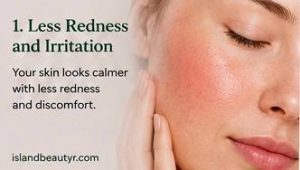
4. Persistent Redness Starts to Calm Down
Redness can be another visible clue during skin barrier recovery, particularly when it developed alongside irritation.
You might notice that your skin no longer stays red for as long after cleansing. Perhaps your cheeks recover more quickly after applying skincare, or your complexion simply looks calmer throughout the day.
These can be encouraging signs your skin barrier is healing.
However, redness deserves some caution.
Not all redness is caused by a damaged barrier. Rosacea, eczema, acne inflammation, allergic reactions, and environmental exposure can all produce redness.
For that reason, do not judge your barrier only by whether your face looks less red on one particular day.
Instead, look for a consistent pattern: less irritation, less burning, better hydration, and gradually reduced redness together are much more meaningful.
5. Flaking and Dry Patches Become Less Frequent
If you have ever dealt with a damaged skin barrier, you may recognize the cycle of dry patches and peeling.
The skin around the nose, mouth, cheeks, or eyebrows can become rough and flaky. Makeup may emphasize every dry area, and applying certain products can make the peeling more obvious.
As the skin barrier heals, these symptoms can gradually become less noticeable.
You may see:
- Less peeling around the nose.
- Fewer dry patches
- Less flaking after cleansing
- A smoother surface
- Reduced roughness
Better hydration can improve the physical properties of the stratum corneum, making the surface feel softer and more flexible.
This does not mean normal skin shedding has stopped. Instead, the outer layer is better hydrated and functioning more effectively.
A reduction in persistent flaking, especially when combined with less tightness and irritation, is therefore another useful sign of skin barrier healing.
6. Your Skin Feels Softer and More Flexible
Sometimes your skin feels healthier before it looks healthier.
When the outer layer is very dry, your face may feel rough, stiff, or almost papery. Smiling or making facial expressions can make the dryness more noticeable.
As hydration improves, that sensation can change.
Your skin may become:
- Softer
- More supple
- Less rough
- More flexible
- More comfortable when you move your face
This is one reason why evaluating skin barrier recovery should involve more than looking at your reflection.
A person can still have acne, enlarged pores, pigmentation, or uneven tone while their barrier is improving.
The goal of barrier repair is not flawless skin. It is better function and greater resilience.
7. Your Skin Handles Weather Changes Better
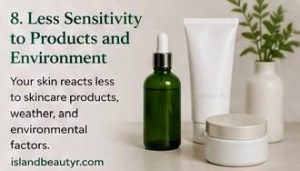
Your skin barrier has to deal with more than skincare products.
Cold wind, dry air, heat, air conditioning, frequent washing, and friction can all challenge the outer layer.
When the barrier is compromised, normal environmental changes may suddenly feel much harsher.
For example, air conditioning might leave your face extremely dry, or cold weather may cause your cheeks to sting.
As skin barrier healing progresses, these reactions may become less intense.
You may notice that your skin:
- Remains comfortable longer in dry air
- Becomes less irritated in cold weather
- Recovers more quickly after environmental exposure
- Requires less emergency moisturizing
This does not mean a healthy barrier makes your skin immune to environmental stress.
Instead, it means your skin is better able to maintain its balance when exposed to everyday conditions.
That increased resilience is one of the more overlooked signs your skin barrier is healing.
8. Your Skin Looks Calmer Even If You Still Have Acne
This is an important point because many people expect barrier repair to solve every skin problem.
It does not.
You can have acne and a relatively healthy skin barrier. You can also have pigmentation, visible pores, or occasional breakouts while your barrier is recovering.
What may change is the overall quality of your skin.
Your complexion may look:
- Less dull
- Less dry
- Less irritated
- More hydrated
- Smoother
- More comfortable
This is a different kind of improvement.
If your skin looks calmer even though your acne has not completely disappeared, that can still be one of the signs your skin barrier is healing.
Do not use the number of pimples alone to judge barrier health.
9. You Stop Needing to “Rescue” Your Skin
Perhaps the most practical of all the signs your skin barrier is healing is that your skin becomes less demanding.
When your barrier is struggling, you may constantly think about what to apply next.
Your face feels dry, so you add another moisturizer.
Then it feels irritated, so you try a soothing serum.
The next morning, you notice flakes and add another product.
Eventually, your routine becomes complicated simply because you are trying to keep your skin comfortable.
As the skin barrier heals, that cycle can become less intense.
Your regular moisturizer may be enough. Your normal cleanser may feel comfortable. You may go through the day without constantly thinking about dryness, burning, or tightness.
That stability is valuable.
Healthy skin does not need to feel perfect every minute. It should simply be able to maintain reasonable comfort without constant intervention.
How Do You Know If Your Skin Barrier Is Healing?
The easiest mistake is looking for one dramatic sign.
Instead, look for several changes occurring together.
Ask yourself:
- Does my skin feel less tight after cleansing?
- Does hydration last longer?
- Do skincare products sting less?
- Are dry patches becoming less common?
- Is redness less persistent?
- Does my skin feel softer?
- Does it handle weather changes better?
- Do I need fewer “rescue” products?
If several of these changes are happening consistently, your skin barrier may be recovering.
There is no simple at-home test that can confirm complete barrier recovery. Researchers can use objective measurements such as TEWL to evaluate aspects of skin barrier function, but these measurements can vary depending on the testing conditions and body site.
For everyday skincare, therefore, the trend matters more than one unusually good or bad day.
How Long Does Skin Barrier Healing Take?
There is no universal timeline for skin barrier healing.
A mildly irritated barrier may improve relatively quickly after the irritating trigger is removed. More significant or repeated disruption can take considerably longer.
The cause matters too.
Over-cleansing for several days is very different from dealing with an ongoing inflammatory skin condition.
You may also notice different signs your skin barrier is healing at different times.
Burning might decrease first. Then your skin may retain moisture better. Flaking may take longer to disappear, while overall resilience can take even longer to return.
Instead of expecting a specific number of days, look for a gradual trend toward better comfort and stability.
What Helps Support Skin Barrier Healing?
Once you begin noticing the signs your skin barrier is healing, the goal is to protect that progress.
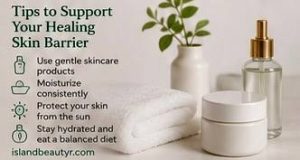
Keep Your Routine Simple
You do not need a ten-step routine to support a healthy skin barrier.
A gentle cleanser, suitable moisturizer, and sunscreen can provide a practical foundation while your skin is recovering.
Avoid repeatedly changing products because it makes it harder to identify what your skin tolerates.
Moisturize Consistently
Moisturizers can support the skin in several ways.
Humectants attract water, emollients improve softness and flexibility, and occlusive ingredients reduce water loss from the surface.
The best combination depends on your skin type and individual needs.
Consider Ceramides
Ceramides are naturally occurring lipids found in the stratum corneum. Together with cholesterol and fatty acids, they contribute to the organized lipid structure that supports the skin’s permeability barrier.
Research has investigated ceramide-containing formulations for improving hydration and supporting aspects of barrier function.
However, simply seeing “ceramides” on a product label does not guarantee that every formulation will work equally well. The overall formulation matters.
Be Careful with Strong Actives
One common mistake is feeling better and immediately returning to aggressive exfoliation.
If your skin is recovering, adding multiple acids, retinoids, scrubs, or other potentially irritating products at the same time can undo your progress.
Give your skin time to become stable before increasing the intensity of your routine.
Signs Your Skin Barrier Is Healing vs. Still Struggling
| Healing Skin Barrier | Barrier May Still Be Compromised |
|---|---|
| Less tightness | Persistent tightness |
| Hydration lasts longer | Dryness returns quickly |
| Less stinging | Frequent burning |
| Reduced flaking | Repeated peeling |
| Softer texture | Persistent roughness |
| Better product tolerance | Basic products sting |
| More stable skin | Frequent irritation |
| Better environmental tolerance | Weather causes strong reactions |
These signs can help you monitor your progress, but they cannot replace a medical diagnosis.
When Should You See a Dermatologist?
Not every case of dry or sensitive skin is simply a damaged barrier.
If your skin remains severely red, itchy, painful, swollen, cracked, or persistently irritated despite simplifying your routine, something else may be contributing to the problem.
Conditions such as eczema, rosacea, contact dermatitis, and other inflammatory disorders can affect barrier function.
If symptoms repeatedly return or fail to improve, professional evaluation is more useful than continuously adding new skincare products.
Frequently Asked Questions
What are the first signs your skin barrier is healing?
The earliest signs your skin barrier is healing can include reduced tightness, less burning or stinging, improved moisture retention, and greater comfort after cleansing. These changes may happen before your skin texture completely normalizes.
Does less redness mean my skin barrier is healing?
Sometimes. If the redness developed together with irritation and gradually decreases as your skin becomes more comfortable, it can be an encouraging sign. However, persistent redness can have many causes.
Does hydrated skin mean your skin barrier is repaired?
Not necessarily. Temporary hydration does not automatically mean complete barrier recovery. More convincing signs your skin barrier is healing include longer-lasting hydration combined with reduced sensitivity and improved product tolerance.
Can your skin barrier heal while you still have acne?
Yes. Acne and barrier function are separate concerns. You can continue to have breakouts while your skin becomes less dry, less sensitive, and more resilient.
Are ceramides helpful for a healing skin barrier?
Ceramides are important components of the stratum corneum’s lipid structure. Appropriately formulated ceramide-containing products may support hydration and barrier function.
How do I know if my skin barrier is fully healed?
There is no simple home test that confirms complete recovery. Stable hydration, minimal irritation, improved product tolerance, and better resilience are encouraging signs your skin barrier is healing. Scientific studies may use measurements such as TEWL to assess barrier function more objectively.

Conclusion
The signs your skin barrier is healing are often subtle at first.
Your face may simply feel less tight after cleansing. Your moisturizer may last longer. Products that once stung may become comfortable again. Dry patches may disappear, your texture may feel softer, and your skin may tolerate everyday environmental changes better.
Those small improvements matter.
Remember that skin barrier healing is about function, not perfect-looking skin. You can still have acne, pores, pigmentation, or occasional breakouts while your barrier is becoming stronger.
The most useful thing you can do is give your skin consistency. Keep cleansing gently, moisturize regularly, avoid unnecessary irritation, and resist the urge to add several strong products as soon as your skin starts improving.
If persistent burning, severe redness, itching, cracking, or sensitivity continues, consider getting professional advice rather than assuming that you simply need a stronger moisturizer.
Ultimately, a healthy barrier is skin that can retain moisture, tolerate everyday stress, and maintain comfort without needing to be constantly “rescued.”