
Skin Barrier Recovery Timeline: 7 Science-Backed Stages to Repair Damaged Skin in 2026
If your skin suddenly feels tight, dry, irritated, unusually sensitive, or prone to burning, you may be dealing with a damaged skin barrier. But one of the biggest questions is: how long does it actually take for the skin barrier to recover?
The skin barrier recovery timeline isn’t the same for everyone. Mild irritation may improve within days, while a more severely disrupted barrier can take several weeks to regain normal function. The cause of the damage, your skin condition, environmental exposure, skincare routine, and how quickly you stop irritating triggers can all influence recovery.
The good news is that the skin has an impressive ability to repair itself. The outermost layer of the epidermis, particularly the stratum corneum, continuously renews and reorganizes its lipids and proteins to maintain protection against water loss and environmental stressors.
This guide explains the skin barrier recovery timeline step by step, what you can realistically expect during each stage, and how to support barrier repair without accidentally slowing it down.
This is islandbeautyr.com, and I am Rasta Kafashan, the author of this website. I can help you better understand and become more aware of your skin, based on the most up-to-date scientific research. So, stay with us and follow islandbeautyr.com.
What Is the Skin Barrier?
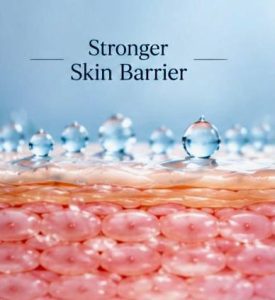
The skin barrier is the protective system that separates your body from the outside environment. Although several skin layers contribute to barrier function, the stratum corneum plays a particularly important role.
It contains corneocytes surrounded by an extracellular lipid matrix composed largely of ceramides, cholesterol, and free fatty acids. Together, these components help limit excessive water loss while providing protection against external substances.
When this system becomes disrupted, the skin can lose water more easily. This process is commonly evaluated scientifically using transepidermal water loss (TEWL).
Higher TEWL generally indicates impaired barrier function. As the barrier improves, water retention can increase, and TEWL can move toward healthier levels.
This is why visible improvement does not always mean that the barrier is completely repaired.
What Causes a Damaged Skin Barrier?
Before discussing the skin barrier recovery timeline, it is important to understand what may have caused the damage.
Common triggers include:
- Over-exfoliation
- Excessive use of acids
- Frequent use of retinoids
- Harsh cleansing
- Hot water
- Scrubbing or physical exfoliation
- Excessive washing
- Very dry or cold weather
- Low-humidity environments
- Irritating cosmetic ingredients
- Certain dermatological treatments
- Inflammatory skin conditions
Sometimes the problem is not a single product. Instead, several irritating factors accumulate over time.
For example, using an exfoliating acid every night while also using a retinoid and cleansing aggressively may create more irritation than the skin can compensate for.
Skin Barrier Recovery Timeline: What to Expect
There is no universal seven-day or fourteen-day rule for skin barrier repair. Scientific studies using controlled irritation models demonstrate that recovery can continue for several weeks, and different measurements of skin function can return to normal at different rates.
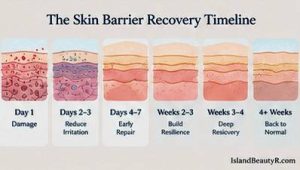
The following timeline is therefore a practical framework rather than a guaranteed biological schedule.
Stage 1: The First 24 Hours — Stop the Damage
The first step in the skin barrier recovery timeline is not adding more products.
It is removing the factors that are continuing to damage the barrier.
If your skin is burning or unusually sensitive, temporarily simplify your routine. Avoid introducing new active ingredients and consider pausing products that commonly increase irritation, such as strong exfoliating acids, aggressive scrubs, or other irritating treatments.
During this period, the skin may feel:
- Tight
- Hot
- Dry
- Sensitive
- Rough
- More reactive than usual
The goal is to reduce additional stress so that the skin can begin repairing itself.
Stage 2: Days 2–3 — Reduce Water Loss and Irritation
During the next few days, the focus shifts toward protecting the skin from additional water loss.
A gentle cleanser and a bland moisturizer can help maintain hydration while minimizing unnecessary irritation.
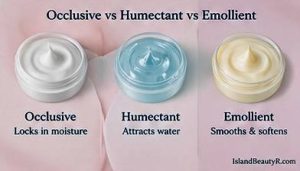
Moisturizers work through different mechanisms. Humectants attract water, emollients help smooth the spaces between skin cells, and occlusive ingredients reduce water evaporation from the surface.
Research on experimentally disrupted skin suggests that appropriate moisturizing treatment can accelerate recovery of barrier function, with improvements in TEWL observed during treatment.
However, more moisturizer does not necessarily mean faster recovery.
The goal is consistent barrier support, not applying multiple layers of products simply because the skin feels dry.
Stage 3: Days 4–7 — Early Barrier Repair
During the first week, some people notice that their skin becomes less uncomfortable.
Burning may decrease. Tightness may become less noticeable, and the skin may begin feeling softer.
However, this does not necessarily mean the barrier has completely recovered.
One important concept in the skin barrier recovery timeline is the difference between symptom improvement and complete functional recovery.
Your skin may look better before its barrier function has fully normalized.
Controlled studies of irritant-induced skin damage have demonstrated that different features of irritation recover at different speeds. Hydration, erythema, and TEWL do not necessarily return to baseline simultaneously.
This is one reason why restarting strong active ingredients too quickly can cause irritation to return.
Stage 4: Week 2 — Noticeable Improvement
For mild barrier disruption, the second week can bring a significant improvement in comfort and appearance.
You may notice:
- Less flaking
- Reduced tightness
- Less stinging
- Better moisturizer tolerance
- Smoother texture
- Less sensitivity to water or skincare products
Research involving acute irritant dermatitis has found that several skin-function measurements may require approximately two weeks to normalize, depending on the model and measurement used.
This does not mean every damaged skin barrier requires exactly two weeks.
The severity and cause of the damage matter enormously.
A mildly over-exfoliated barrier may recover relatively quickly, whereas chronic inflammation, dermatitis, repeated irritation, or ongoing exposure to the original trigger can prolong recovery.
Stage 5: Weeks 2–3 — Rebuilding Barrier Resilience
At this point in the skin barrier recovery timeline, the skin may look almost normal.
But resilience is important.
Healthy barrier function is not simply about having hydrated-looking skin. The barrier must also tolerate normal environmental exposure without immediately becoming irritated.
One of the major structural components involved in this process is the intercellular lipid matrix of the stratum corneum.
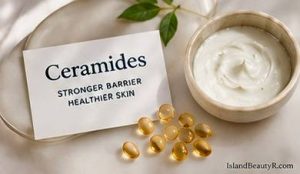
Why Ceramides Matter
Ceramides are essential lipids found in the stratum corneum. Along with cholesterol and free fatty acids, they help create the organized lipid structures required for an effective epidermal barrier.
When barrier function is impaired, changes in ceramide content and lipid organization can contribute to increased water loss and dryness.
Research reviewing clinical studies has found that ceramide-containing formulations can improve hydration and aspects of barrier function, particularly in conditions associated with impaired barrier function. If you’re looking for practical options, our guide to ceramide moisturizers for barrier repair explains what to look for in a formula.
This does not mean every person with irritated skin needs a ceramide product. It means that well-formulated moisturizers containing barrier-supportive lipids can be a reasonable component of a simple recovery routine.
Stage 6: Weeks 3–4 — Deeper Functional Recovery
A common mistake is assuming that normal-looking skin automatically means the recovery process is finished.
Scientific evidence suggests that irritant-induced barrier disruption can remain functionally abnormal after visible symptoms have improved.
In one controlled human study, several parameters returned toward normal around two weeks, while complete recovery of skin function and irritant reactivity occurred at approximately four weeks.
Another experimental study found complete repair of an irritant reaction approximately 17 days after exposure, demonstrating that recovery time can vary depending on the irritant and the biological endpoint being measured.
Therefore, a realistic skin barrier recovery timeline for uncomplicated irritation may range from days to several weeks rather than following one fixed number.
Stage 7: After 4 Weeks — Gradual Return to Actives
If your skin has been consistently comfortable for several weeks, you may be able to gradually reintroduce active skincare ingredients.
The key word is gradually.
Do not restart every active product simultaneously.
For example, if you previously used a retinoid, exfoliating acid, vitamin C product, and multiple acne treatments, introducing all of them at once makes it difficult to determine which product your skin can tolerate.
A slower approach gives you a better opportunity to identify irritation before it becomes significant.
The goal is not merely to finish the skin barrier recovery timeline. The goal is to maintain the barrier afterward.
How to Tell If Your Skin Barrier Is Healing
Several practical signs may indicate that your barrier is improving. For a more detailed checklist, see our guide to the signs your skin barrier is healing.

1. Less Burning
Products that previously caused mild stinging may become more comfortable.
2. Reduced Tightness
The skin may stop feeling stretched immediately after cleansing.
3. Less Flaking
Dry patches and visible scaling may gradually decrease.
4. Better Hydration
The skin may feel softer and more flexible throughout the day.
5. Improved Product Tolerance
A basic moisturizer and gentle cleanser should become easier to tolerate.
6. Reduced Reactivity
Your skin may become less reactive to normal environmental changes.
7. More Stable Texture
Roughness can gradually decrease as hydration and barrier function improve.
Remember that these signs are useful observations, not laboratory measurements. A dermatologist can assess persistent inflammation or another underlying skin condition when symptoms do not improve.
The Best Routine During Skin Barrier Recovery
A simple routine is usually easier to tolerate than a complicated one.
Morning
1. Gentle cleansing
If your skin is very dry or irritated, you may not need an aggressive cleanser in the morning.
2. Moisturizer
Choose a fragrance-free moisturizer formulated for sensitive or dry skin.
3. Sunscreen
Daily broad-spectrum sunscreen helps protect the skin from ultraviolet radiation while the barrier is recovering.
Evening
1. Gentle cleanser
Use lukewarm water and avoid vigorous rubbing.
2. Moisturizer
Apply a barrier-supportive moisturizer while the skin is still slightly hydrated.
3. Keep the routine simple
Avoid adding several new treatments while trying to determine whether your barrier is recovering.
What Should You Avoid During Barrier Recovery?
Some habits can repeatedly interrupt the skin barrier recovery timeline.
Avoid aggressive exfoliation
Physical scrubs and strong chemical exfoliation can increase irritation when the barrier is already compromised.
Avoid unnecessary product switching.
Trying five different moisturizers in one week makes it difficult to identify what your skin actually tolerates.
Avoid very hot water
Hot water can worsen dryness and discomfort.
Avoid picking and scratching
Mechanical trauma can increase inflammation and interfere with recovery.
Do not chase instant results.
Skin barrier repair is a biological process, not a cosmetic transformation that necessarily happens overnight.
Can a Skin Barrier Recover in 7 Days?
Sometimes, but not always.
Mild irritation may feel substantially better within a week, especially when the trigger is removed, and the skin receives appropriate supportive care.
However, feeling better after seven days does not prove that every aspect of barrier function has returned to baseline.
Controlled studies show that some forms of irritant-induced damage can require two to four weeks for more complete functional recovery.
Therefore, seven days should be viewed as a possible early improvement point, not a universal skin barrier recovery timeline.
Can a Damaged Skin Barrier Take Months to Heal?
It can, particularly when the underlying problem is not simply temporary irritation.
Persistent dermatitis, chronic inflammatory skin conditions, repeated exposure to irritating products, or continued use of a damaging routine can make recovery much slower. If your skin remains unusually reactive or sensitive, our guide to reactive skin barrier care may help you understand the connection between sensitivity and barrier dysfunction.
If your skin remains persistently red, painful, cracked, itchy, swollen, or highly reactive despite simplifying your routine, the problem may be more than ordinary skincare-related barrier disruption.
In those situations, professional dermatological evaluation is more appropriate than continually adding new skincare products.
Skin Barrier Recovery Timeline at a Glance
| Recovery period | What may happen |
|---|---|
| First 24 hours | Irritating triggers are removed |
| Days 2–3 | Burning and tightness may begin decreasing |
| Days 4–7 | Early improvements in comfort and hydration |
| Week 2 | More noticeable reduction in dryness and sensitivity |
| Weeks 2–3 | Barrier resilience gradually improves |
| Weeks 3–4 | Deeper functional recovery may continue |
| 4+ weeks | Gradual return to stronger active ingredients when tolerated |
This table is a general framework, not a medical prediction. Different causes of barrier disruption can produce substantially different recovery patterns.
The Bottom Line
The skin barrier recovery timeline is best understood as a gradual biological process rather than a fixed seven-day challenge.
For mild irritation, noticeable improvement may occur within several days. More substantial barrier disruption may require two to four weeks or longer, particularly when inflammation or repeated irritation is involved.
The most important strategy is surprisingly simple: stop the source of irritation, protect the skin from additional stress, moisturize consistently, and give the epidermis enough time to recover.
Ceramides and other barrier-supportive ingredients can be useful components of a moisturizer, but no single ingredient can replace a consistent routine and removal of the original trigger. Research supports the importance of ceramides and the intercellular lipid matrix in maintaining epidermal barrier function.
Most importantly, do not judge recovery only by how your skin looks. A barrier can appear normal while some aspects of its functional recovery are still progressing.
If your skin continues to burn, crack, itch, or become inflamed despite several weeks of gentle care, consider seeing a dermatologist to determine whether an underlying skin condition is contributing to the problem.