
7 Powerful Signs You Can Over-Moisturize Your Skin — And How to Fix It
Moisturizer is one of the simplest steps in a skincare routine—but more is not always better.
If your skin feels tight, dry, or irritated, adding another layer of moisturizer may seem like the obvious solution. Yet if you constantly apply rich creams, stack multiple hydrating products, or use a heavy moisturizer when your skin does not need it, you may eventually wonder: Can you over-moisturize your skin?
The short answer is yes, your skincare routine can become too moisturizing for your skin, although the problem is usually not that water is somehow “trapped” inside your skin. More often, the issue is an inappropriate product, excessive layering, heavy occlusive ingredients, or using more product than your skin needs.
Understanding the difference matters because healthy skin needs hydration and barrier support—not an endless amount of skincare products.
In this science-backed guide, we’ll explain what happens when you over-moisturize your skin, the warning signs to watch for, how moisturizing ingredients actually work, and how to build a more balanced routine.
This is islandbeautyr.com, and I am Rasta Kafashan, the author of this website. I can help you better understand and become more aware of your skin, based on the most up-to-date scientific research. So, stay with us and follow islandbeautyr.com.
Can You Over-Moisturize Your Skin?
Yes, you can over-moisturize your skin in the practical sense of using too much or using products that are too rich for your skin type.
However, it is important to clarify what “over-moisturizing” actually means.
Your skin naturally regulates water loss through its outermost layer, the stratum corneum. Moisturizers support this system through different mechanisms. Humectants such as glycerin and hyaluronic acid help attract and hold water, while emollients smooth the spaces between skin cells. Occlusives form a surface layer that reduces water loss.
These mechanisms are beneficial, especially when the skin barrier is dry or damaged.
The problem can occur when you repeatedly apply several heavy products even though your skin does not need that much occlusion.
For example, using a hydrating serum, essence, cream, facial oil, sleeping mask, and another layer of moisturizer may be unnecessary for someone with naturally oily or acne-prone skin.
So, can you over-moisturize your skin? Yes—but the better question is whether your routine is providing the right amount and type of moisture for your skin.
What Happens When You Over-Moisturize Your Skin?
Over-moisturizing does not mean your skin becomes permanently dependent on moisturizer or that your skin barrier suddenly stops functioning.
Those popular skincare claims are often exaggerated.
Instead, excessive or poorly matched moisturizing can create several practical problems:
- A greasy or excessively coated feeling
- Increased product buildup
- More visible congestion in some people
- Small bumps or breakouts
- Irritation from repeatedly applying multiple products
- Difficulty identifying which product is causing a reaction
- A routine that becomes unnecessarily complicated
The risk is particularly relevant for people with oily or acne-prone skin. The American Academy of Dermatology recommends choosing products labeled oil-free, non-comedogenic, or “won’t clog pores” when breakouts are a concern.
Importantly, moisturizer itself is not the enemy of acne-prone skin.
In fact, dermatologists often recommend moisturizer alongside acne treatments because ingredients such as benzoyl peroxide, salicylic acid, adapalene, tretinoin, and isotretinoin can cause dryness and irritation.
The goal is balance—not avoiding moisturizer altogether.
7 Signs You May Over-Moisturize Your Skin
If you are wondering whether you over-moisturize your skin, look for patterns rather than one isolated symptom.
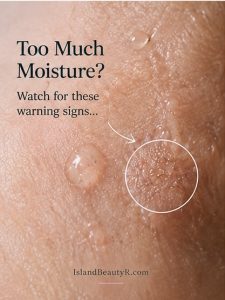
1. Your Skin Stays Greasy for Hours
A slight dewy finish is normal. But if your face remains unusually slick, heavy, or coated long after applying your skincare, your moisturizer may simply be too rich for your skin.
This is especially common when someone with oily or combination skin uses a thick cream designed for very dry skin.
A lightweight gel or lotion may provide enough hydration without leaving a heavy film.
The AAD similarly recommends lighter gel formulations for some people with oily skin.
2. You Suddenly Notice More Tiny Bumps
One of the most frustrating signs that you may over-moisturize your skin is the appearance of small, persistent bumps.
These can sometimes be closed comedones, but not every tiny bump is caused by moisturizer.
Other possibilities include milia, acne, irritation, folliculitis, or simply normal skin texture.
If the bumps consistently appear after introducing a new rich moisturizer or layering several products, however, your routine deserves closer examination.
Rather than immediately blaming “too much hydration,” look at the complete formula and everything else you are applying.
3. Your Pores Look More Congested
When several rich products are layered repeatedly, some people may notice that their skin looks more congested.
This does not mean every occlusive ingredient is pore-clogging.
For example, dimethicone is an occlusive and emollient ingredient that can reduce transepidermal water loss while generally being considered suitable for acne-prone skin.
The bigger issue is the overall formulation and your individual response, rather than simply labeling all occlusives as bad.
If your pores appear increasingly congested after changing your routine, simplify the routine for a few weeks and monitor the pattern.
4. Your Skin Feels Heavy or “Coated”
Healthy hydrated skin should generally feel comfortable—not as though several layers are sitting on top of it.
If your face feels sticky, slippery, waxy, or unusually coated throughout the day, you may be applying more product than necessary.
This is particularly easy to do when you combine:
- Hydrating toner
- Essence
- Hyaluronic acid serum
- Multiple serums
- Moisturizer
- Facial oil
- Sleeping mask
Every individual product may be reasonable, but using all of them together may be unnecessary.
Your skin does not need a complicated routine simply because more hydration sounds beneficial.
5. Makeup Starts Sliding or Separating
Another practical clue is how your makeup behaves.
If foundation suddenly slides around, separates, pills, or refuses to settle after your skincare routine, the problem may be excessive product layering.
This does not automatically mean you over-moisturize your skin. Sunscreen, silicone-heavy formulas, incompatible products, and application technique can also cause pilling.
However, if the problem started immediately after adding multiple moisturizing layers, reducing the number of layers may help.
6. You Keep Adding Moisturizer Because Your Skin Still Feels “Dry”
This is one of the most confusing situations.
You moisturize your face repeatedly, but it still feels tight.
Instead of automatically adding more cream, consider whether your skin barrier is irritated.
Over-cleansing, harsh exfoliation, hot water, low humidity, and irritating active ingredients can contribute to dryness and barrier disruption. Moisturizers can help reduce water loss, but continuously adding layers does not necessarily address the underlying cause.
Sometimes the better strategy is to simplify your routine and remove the irritant.
7. Your Routine Has Become Much More Complicated Than Your Skin Needs
A surprisingly important sign is complexity itself.
If you need six or seven moisturizing steps to make your skin feel comfortable, it may be worth asking why.
A basic routine can often provide substantial barrier support:
Gentle cleanser → appropriate moisturizer → sunscreen in the morning
Additional products can be added according to specific needs.
For acne-prone skin, dermatologists emphasize gentle cleansing and non-comedogenic products rather than aggressive cleansing or excessive product use.
Moisturizer vs. Over-Moisturizing: What Is the Difference?
The distinction is important because moisturizing is not inherently bad.
| Healthy Moisturizing | Potential Over-Moisturizing |
|---|---|
| Supports the skin barrier | Uses more products than necessary |
| Reduces dryness | Leaves persistent heaviness or greasiness |
| Helps reduce water loss | May contribute to congestion in some people |
| Improves comfort | Can make routines unnecessarily complicated |
| Uses a product suited to skin type | Uses a formula that is too rich |
| Supports acne treatment-related dryness | May aggravate breakouts if poorly matched |
The objective is not to eliminate moisturizer.
It is to find the minimum effective routine that keeps your skin comfortable and your barrier supported.
Which Moisturizing Ingredients Matter Most?
Understanding moisturizer ingredients can help you avoid the misconception that every moisturizing product works in exactly the same way.
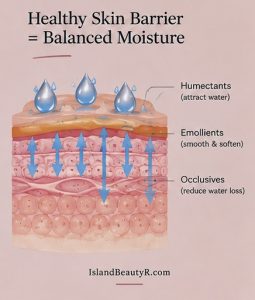
Humectants
Humectants attract and retain water.
Common examples include:
- Glycerin
- Hyaluronic acid
- Urea
- Certain forms of alpha hydroxy acids at appropriate concentrations
Glycerin, in particular, is a well-established humectant used in moisturizing formulations.
Emollients
Emollients help smooth the skin surface and improve its softness by filling spaces between corneocytes.
Examples include certain fatty acids, esters, and oils.
Occlusives
Occlusives reduce water loss from the skin surface by creating a protective layer.
Examples include:
- Petrolatum
- Dimethicone
- Certain waxes and oils
Occlusives can be extremely useful when the skin barrier is damaged or very dry. The problem is not that occlusion is inherently harmful; rather, the level of occlusion should match your skin’s needs.
Can Over-Moisturizing Cause Acne?
This question deserves a nuanced answer.
Moisturizer does not automatically cause acne.
In fact, appropriate moisturization can be helpful for acne-prone skin because excessive dryness and irritation can make acne treatment harder to tolerate.
However, a moisturizer that is too heavy for a particular person, combined with multiple occlusive layers or other unsuitable products, may contribute to congestion or breakouts.
That is why dermatologists commonly recommend non-comedogenic products for people who are prone to acne.
So rather than asking:
”Dose moisturizer cause acne?”
A more useful question is:
“Is this particular moisturizer appropriate for my skin and the rest of my routine?”
How to Stop Over-Moisturizing Your Skin
If you think you over-moisturize your skin, you usually do not need to stop moisturizing completely.
Try a simpler approach.
Step 1: Reduce the Number of Hydrating Layers
Temporarily remove unnecessary essences, multiple hydrating serums, facial oils, and sleeping masks.
Keep one moisturizer that meets your skin’s needs.
Step 2: Choose the Right Texture
If your skin is oily or acne-prone, a lightweight gel or lotion may feel more comfortable.
If your skin is very dry, a cream or ointment may be more appropriate. The AAD notes that creams and ointments generally provide more intensive moisturization than lotions.
Step 3: Apply a Reasonable Amount
More product does not automatically mean better hydration.
A thin, even layer is usually a better starting point than repeatedly adding thick layers.
Step 4: Apply Moisturizer to Slightly Damp Skin
Applying moisturizer after cleansing while the skin is still slightly damp can help trap water and improve moisturization.
Step 5: Give Your Routine Time
Do not change five products simultaneously.
If your skin becomes congested after introducing a new moisturizer, changing several products at once makes it almost impossible to identify the cause.
How Much Moisturizer Does Your Skin Actually Need?
There is no universal amount that works for everyone.
Your ideal amount depends on:
- Skin type
- Climate
- Season
- Humidity
- Current skin-barrier condition
- Acne treatment
- Product formulation
- Body area
For example, someone living in a cold, dry environment may need a richer cream than someone living in a hot and humid climate.
Likewise, someone experiencing medication-related dryness may require more frequent moisturizing.
The American Academy of Dermatology recommends adjusting moisturizer use according to dryness and choosing formulations appropriate for individual skin needs.
What If Your Skin Is Oily but Dehydrated?
This is where skincare becomes confusing.
Oily and dehydrated are not opposites.
Oily skin describes the amount of sebum your skin produces, while dehydration refers to insufficient water in the outer layers of the skin.
You can therefore have skin that looks shiny while simultaneously feeling tight.
The solution is not necessarily to use an extremely rich moisturizer.
A lightweight, non-comedogenic moisturizer containing humectants can provide hydration without making the skin feel excessively greasy.
The AAD recommends balancing oil control with preservation of the skin’s natural moisture rather than aggressively stripping oily skin.
What About Skin Barrier Repair?
If your skin barrier is damaged, moisturizing becomes especially important.
A compromised barrier can increase water loss and contribute to dryness, irritation, and sensitivity. Research reviews describe moisturizers as supporting the physical skin barrier through combinations of humectant, emollient, and occlusive mechanisms.
This creates an important distinction:
A damaged barrier may need more supportive moisturization, while healthy oily skin may need less occlusive moisturization.
That is why there is no single “correct” amount of moisturizer for every person.
Can You Over-Moisturize While Using Acne Treatments?
Yes, but the solution is usually not to stop moisturizing.
Acne treatments such as retinoids, benzoyl peroxide, and salicylic acid can cause dryness and irritation. Moisturizer can improve comfort and help people tolerate treatment.
For people using isotretinoin, dryness is particularly common, and the AAD recommends oil-free or non-comedogenic moisturizers and application while the skin is still damp.
The goal is to provide enough barrier support without automatically layering increasingly heavy products.
A Simple Moisturizing Routine for Different Skin Types
| Skin Type | Generally Suitable Approach |
|---|---|
| Oily | Lightweight gel or lotion |
| Combination | Light moisturizer overall; more on dry areas |
| Normal | Lotion or lightweight cream |
| Dry | Cream with humectants, emollients, and occlusives |
| Very dry/barrier-damaged | Rich cream or ointment when appropriate |
| Acne-prone | Non-comedogenic, lightweight moisturizer |
| Sensitive | Fragrance-free, simple formulation |
These are starting points rather than strict rules. Your skin’s response matters more than a label.
Frequently Asked Questions
Can you over-moisturize your skin overnight?
Yes. Sleeping masks and multiple layers of rich creams can create more occlusion than necessary, particularly for oily or acne-prone skin. If you wake up with a persistently greasy or congested face, simplify your nighttime routine.
Can over-moisturizing cause closed comedones?
It can contribute to congestion in some people, particularly when a rich or unsuitable formulation is combined with multiple layers. However, closed comedones have several causes, so moisturizer should not automatically be blamed.
Should I stop using moisturizer if my skin is oily?
Usually, no. Oily skin can still become dehydrated or irritated. Instead, consider a lightweight, non-comedogenic moisturizer and avoid unnecessarily heavy formulations.
Is hyaluronic acid enough as a moisturizer?
Not necessarily. Hyaluronic acid is primarily a humectant. Depending on your skin and environment, you may also benefit from emollient and/or occlusive ingredients that help reduce water loss.
Can moisturizer make pores bigger?
Moisturizer does not literally enlarge your pores. However, excessive product buildup, oiliness, congestion, or a formulation that does not suit your skin can make pores appear more noticeable.
How long does it take for skin to recover after over-moisturizing?
There is no fixed recovery period because “over-moisturizing” is not a specific medical diagnosis. If the issue is simply excess product, simplifying your routine may quickly improve the feel of your skin. If you have persistent acne, irritation, rash, or inflammation, the underlying cause may be something else.
What is the best moisturizer if I have acne-prone skin?
Look for products labeled non-comedogenic, oil-free, or won’t clog pores, and choose a texture that feels comfortable for your skin.
The Bottom Line: Can You Over-Moisturize Your Skin?
So, can you over-moisturize your skin?
Yes—but the science is more nuanced than the idea that “too much moisturizer destroys your skin.”
Moisturizers are important tools for maintaining hydration and supporting the skin barrier. Humectants, emollients, and occlusives each work differently, and the right combination can be particularly helpful when the skin is dry, irritated, or undergoing acne treatment.
The real problem is usually mismatch.
A very rich cream may be excellent for severely dry skin but unnecessary for oily skin. Multiple hydrating layers may be comfortable for someone with a damaged barrier but excessive for someone whose skin is already well balanced.
Instead of chasing the maximum amount of moisture, aim for skin balance.
Your ideal routine should leave your skin comfortable, supple, and protected—not permanently greasy, coated, congested, or dependent on six different moisturizing products.
When it comes to skincare, more steps do not necessarily mean better skin.
The goal is not maximum moisture. The goal is the right moisture for your skin.
References
- American Academy of Dermatology. Moisturizer: Why you may need it if you have acne.
- American Academy of Dermatology. How to pick the right moisturizer for your skin.
- Chularojanamontri L, et al. Moisturizers for Acne: What are their Constituents? Journal of Clinical and Aesthetic Dermatology.
- The Skin Barrier and Moisturization: Function, Disruption, and Mechanisms of Repair. PubMed.
- American Academy of Dermatology. Isotretinoin: How to manage side effects.
- Insights into acne and the skin barrier: Optimizing treatment regimens with ceramide-containing skincare. PubMed.
Medical Disclaimer
This article is for educational purposes only and does not replace professional medical advice, diagnosis, or treatment. Persistent acne, painful inflammation, severe irritation, swelling, or a rash should be evaluated by a qualified dermatologist.
Pingback: 9 Powerful Ways to Treat Closed Comedones + 9 Science-Backed Causes - IslandBeautyR