
Hyaluronic Acid for Skin Barrier Repair: 11 Proven Benefits Every Skincare Lover Should Know
Walk into any skincare store or browse your favorite beauty website, and you’ll quickly notice one ingredient appearing almost everywhere: hyaluronic acid.
From lightweight serums to dermatologist-recommended moisturizers, it’s often promoted as the ultimate solution for dry, dehydrated, and sensitive skin. Some brands even claim it can repair a damaged skin barrier on its own.
But is that really true?
The answer is more nuanced than most marketing campaigns suggest.
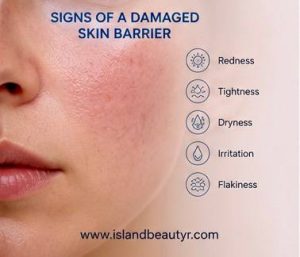
Hyaluronic Acid for Skin Barrier Repair is one of the most searched skincare topics today because millions of people experience redness, tightness, irritation, and dehydration without realizing that these symptoms often point to a weakened skin barrier rather than simply “dry skin.”
A compromised skin barrier struggles to hold onto moisture and defend itself against everyday stressors such as pollution, harsh cleansers, over-exfoliation, and changing weather. Because hyaluronic acid is exceptionally effective at attracting water, many people assume it directly repairs this protective layer.
Scientific research tells a different story.
While Hyaluronic Acid for Skin Barrier Repair plays an important role in supporting recovery, it doesn’t physically rebuild the barrier itself. Instead, it creates the ideal environment for healing by improving hydration, reducing discomfort, and helping the skin function more efficiently while essential barrier lipids restore the damaged structure.
That distinction may sound small, but it completely changes how you should build an effective skincare routine.
If you’re relying on a hyaluronic acid serum alone, you may only be solving half of the problem.
In this evidence-based guide, you’ll learn exactly how Hyaluronic Acid for Skin Barrier Repair works, what modern dermatology says about its benefits and limitations, how it compares with ceramides, which mistakes prevent it from delivering the best results, and how to create the perfect barrier-repair routine for healthier, stronger skin.
This is islandbeautyr.com, and I am Rasta Kafashan, the author of this website. I can help you better understand and become more aware of your skin, based on the most up-to-date scientific research. So, stay with us and follow islandbeautyr.com.
What Is the Skin Barrier?
To understand why Hyaluronic Acid for Skin Barrier Repair has become such an important topic, it’s essential to first understand how the skin barrier works.
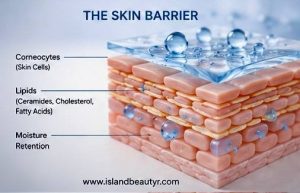
Your skin barrier, scientifically known as the stratum corneum, is the outermost layer of the epidermis. Although it’s incredibly thin, it performs one of the body’s most demanding jobs—protecting your skin every second of the day.
Dermatologists often compare this structure to a brick wall.
The skin cells, called corneocytes, act as the bricks, while a mixture of ceramides, cholesterol, and free fatty acids forms the mortar that seals those bricks together.
When this protective wall is healthy, it continuously performs several essential functions.
It helps to:
- Prevent excessive water loss.
- Maintain long-lasting hydration.
- Block bacteria, allergens, and pollutants.
- Reduce irritation from environmental stress.
- Support healthy skin renewal.
- Improve resilience against daily damage.
Unfortunately, the skin barrier can become weakened more easily than many people realize.
Overusing exfoliating acids, applying retinoids too frequently, washing with harsh cleansers, taking long hot showers, spending time in cold weather, or even chronic stress can gradually damage the barrier.
Once that happens, water escapes from the skin much faster through transepidermal water loss (TEWL). At the same time, irritants penetrate the skin more easily, leading to dryness, redness, sensitivity, burning, itching, and persistent discomfort.
This is exactly why Hyaluronic Acid for Skin Barrier Repair has attracted so much attention. Increasing hydration can significantly improve how damaged skin feels, but whether hydration alone is enough to repair the barrier is a question that deserves a closer scientific look.
What Is Hyaluronic Acid?
Before exploring Hyaluronic Acid for Skin Barrier Repair, it’s worth taking a closer look at what hyaluronic acid actually does inside the skin.
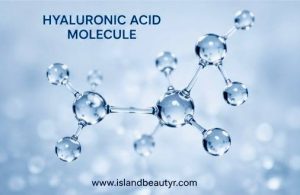
Despite its name, hyaluronic acid isn’t an exfoliating acid like glycolic acid or salicylic acid. Instead, it’s a naturally occurring molecule that belongs to a family of complex sugars called glycosaminoglycans (GAGs). These molecules are found throughout the body—in your joints, eyes, connective tissues, and especially your skin—where they play a crucial role in maintaining hydration.
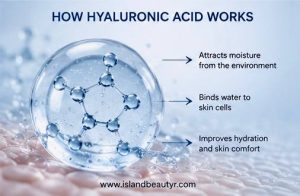
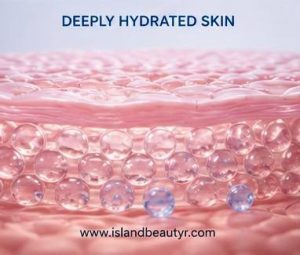
Almost half of the body’s hyaluronic acid is stored within the skin. Here, it acts as a natural moisture reservoir, continuously binding and holding water to help the skin stay smooth, flexible, and resilient.
One reason hyaluronic acid has become such a popular skincare ingredient is its extraordinary ability to attract water. While the often-repeated claim that it holds “1,000 times its weight in water” oversimplifies the science, there’s no doubt that it is one of the most effective humectants used in modern skincare.
When applied topically, hyaluronic acid helps draw water toward the outer layers of the skin. As hydration levels increase, the skin immediately feels softer, looks plumper, and fine dehydration lines become less noticeable. This instant improvement is one reason many people believe Hyaluronic Acid for Skin Barrier Repair works by rebuilding the barrier itself.
The reality is more complex.
Hydration is one of the requirements for a healthy barrier, but hydration alone doesn’t replace damaged structural lipids or repair microscopic gaps between skin cells.
Understanding that difference is essential if your goal is long-term skin barrier recovery rather than temporary relief.
How Does Hyaluronic Acid Support Skin Barrier Repair?
Although hyaluronic acid doesn’t rebuild the skin barrier directly, it plays several important supporting roles during the healing process. These benefits explain why Hyaluronic Acid for Skin Barrier Repair has become a cornerstone of many dermatologist-recommended routines.
1. It Restores Moisture Where the Skin Needs It Most
A damaged skin barrier loses water faster than healthy skin. This increase in transepidermal water loss (TEWL) leaves the surface feeling dry, tight, and uncomfortable.
Hyaluronic acid helps counteract this by attracting water into the outer layers of the epidermis. As hydration improves, the skin becomes more comfortable and less prone to the cracking that often accompanies severe dehydration.
While this doesn’t repair the barrier on its own, it creates the conditions needed for natural recovery.
2. It Reduces the Feeling of Tightness
One of the earliest signs of barrier damage is a sensation that the skin feels “too small” after cleansing.
This happens because dehydrated skin loses flexibility.
By increasing water content within the stratum corneum, hyaluronic acid improves elasticity and reduces the uncomfortable tightness that many people experience after washing their face.
For individuals with sensitive skin, this alone can make a noticeable difference in day-to-day comfort.
3. It Supports the Skin’s Natural Repair Processes
Healthy skin is constantly repairing itself.
Every day, new skin cells move toward the surface while specialized enzymes organize lipids and strengthen the protective barrier.
These biological processes function more efficiently in a well-hydrated environment.
Although Hyaluronic Acid for Skin Barrier Repair doesn’t directly produce ceramides or cholesterol, maintaining proper hydration allows the skin’s natural repair mechanisms to operate under more favorable conditions.
4. It Helps Calm Irritated Skin
Not every form of hyaluronic acid behaves the same way.
High-molecular-weight hyaluronic acid remains mostly on the skin’s surface, where it forms a lightweight hydrating film.
This protective layer helps reduce feelings of irritation, improves skin comfort, and temporarily minimizes moisture loss while the barrier continues to recover.
For people experiencing redness or sensitivity, this soothing effect is often one of the first noticeable benefits.
5. It Improves the Performance of Barrier-Repair Products
One of the biggest advantages of Hyaluronic Acid for Skin Barrier Repair is how well it works alongside other skincare ingredients.
Think of hyaluronic acid as the ingredient that prepares the skin, while ceramides, cholesterol, and fatty acids reinforce the barrier itself.
When these ingredients are layered correctly, they complement one another.
Hyaluronic acid boosts hydration.
Ceramides help rebuild the lipid matrix.
Fatty acids strengthen the protective layer.
Cholesterol improves barrier stability.
Together, they provide a more complete approach to skin barrier recovery than any single ingredient alone.
Does Science Support Using Hyaluronic Acid for Skin Barrier Repair?
The growing popularity of Hyaluronic Acid for Skin Barrier Repair isn’t based on marketing alone.
Several clinical and laboratory studies have shown that topical hyaluronic acid can improve several aspects of skin health, including hydration, elasticity, skin smoothness, and overall comfort.
Research also suggests that hyaluronic acid plays a role in wound healing by influencing cell migration, tissue remodeling, and inflammatory signaling. While healing a wound isn’t the same as repairing a damaged skin barrier, both processes rely on many of the same biological pathways.
What researchers consistently emphasize, however, is that hydration should not be confused with structural repair.
Scientific evidence indicates that restoring the lipid matrix—particularly ceramides, cholesterol, and free fatty acids—is essential for rebuilding the skin barrier. Hyaluronic acid supports this process, but it doesn’t replace those lipids.
This is why many dermatologists recommend pairing a hyaluronic acid serum with a ceramide-rich moisturizer instead of relying on hydration alone.
In other words, if you’re using Hyaluronic Acid for Skin Barrier Repair, think of it as part of a complete recovery strategy rather than a standalone solution.
Expert Insight
If your skin barrier is damaged, don’t judge a product simply because it contains hyaluronic acid. Instead, look at the entire formula.
A well-designed barrier-repair moisturizer often combines hyaluronic acid, ceramides, cholesterol, glycerin, panthenol, and squalane. Each ingredient has a different role, and together they create a routine that’s far more effective than relying on any single ingredient in isolation.
Hyaluronic Acid vs. Ceramides: Which Is Better for Skin Barrier Repair?
If you’ve been researching Hyaluronic Acid for Skin Barrier Repair, you’ve probably noticed that ceramides appear in almost every dermatologist-recommended routine. That naturally raises an important question:
If ceramides repair the skin barrier, do you even need hyaluronic acid?
The answer isn’t about choosing one over the other.
It’s about understanding that these ingredients perform completely different jobs.
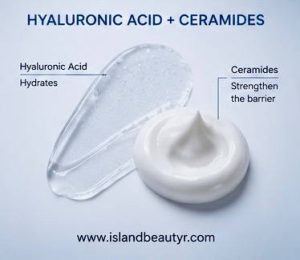
Hyaluronic acid is a humectant. Its primary role is to attract and retain water, helping the skin stay hydrated and comfortable.
Ceramides, on the other hand, are structural lipids. They fill the tiny spaces between skin cells, strengthen the barrier, and reduce moisture loss over time.
Imagine building a house.
Hyaluronic acid is like delivering water to the construction site so the workers can do their job efficiently.
Ceramides are the bricks and cement that rebuild the walls.
Without water, construction becomes more difficult.
Without bricks and cement, nothing meaningful gets rebuilt.
That’s exactly why dermatologists often recommend combining these ingredients instead of choosing one.
Quick Comparison
| Hyaluronic Acid | Ceramides |
|---|---|
| Attracts water into the skin | Restores barrier lipids |
| Improves hydration | Repairs barrier structure |
| Makes skin look plumper | Reduces long-term moisture loss |
| Relieves temporary tightness | Improves barrier resilience |
| Works immediately | Provides gradual, lasting repair |
For most people with a compromised barrier, the most effective routine includes both.
Can Hyaluronic Acid Damage the Skin Barrier?
This question has become increasingly common, especially after viral social media posts claimed that hyaluronic acid can dry out the skin.
So, is there any truth to it?
Not exactly.
Hyaluronic acid itself doesn’t damage the skin barrier. However, the way it’s used can influence how your skin feels.
In very dry environments where humidity is low, hyaluronic acid has less moisture available to attract from the surrounding air. If it’s applied without a moisturizer afterward, water can evaporate more easily, leaving the skin feeling tight or dehydrated.
This doesn’t mean hyaluronic acid is harmful.
It simply means the product wasn’t sealed with ingredients that help prevent moisture loss.
For the best results:
- Apply hyaluronic acid to slightly damp skin.
- Follow immediately with a moisturizer containing ceramides or other barrier-supporting lipids.
- During cold or dry weather, finish with a richer cream if your skin feels dehydrated.
Used this way, Hyaluronic Acid for Skin Barrier Repair becomes significantly more effective.
The Best Ingredients to Pair with Hyaluronic Acid
Hyaluronic acid performs best when it works as part of a complete barrier-repair routine rather than acting alone.
Here are some of the most effective ingredients to combine with it.
Ceramides
Ceramides are considered the gold standard for repairing a compromised skin barrier because they replenish the lipids naturally found between skin cells.
When combined with hyaluronic acid, they provide both immediate hydration and long-term barrier support.
Niacinamide
Niacinamide supports barrier function by encouraging the skin to produce more ceramides while also helping reduce redness and irritation.
For many people, this combination offers noticeable improvements in both hydration and overall skin resilience.
Panthenol (Provitamin B5)
Panthenol attracts moisture while also soothing irritated skin.
It’s particularly useful after over-exfoliation or cosmetic procedures when the skin barrier needs extra support.
Glycerin
Like hyaluronic acid, glycerin is a humectant.
Using both together often provides more consistent hydration than relying on either ingredient alone.
Squalane
Squalane is a lightweight emollient that softens the skin and reduces moisture loss without leaving a heavy or greasy finish.
For people with combination or oily skin, it can be an excellent addition to a barrier-repair routine.
Common Mistakes That Prevent Hyaluronic Acid from Working
Sometimes people conclude that Hyaluronic Acid for Skin Barrier Repair “doesn’t work,” when in reality a few simple mistakes are limiting its effectiveness.
Applying It to Completely Dry Skin
Hyaluronic acid performs best when there is moisture available to bind.
Applying it immediately after cleansing—while the skin is still slightly damp—is usually more effective than waiting until the face is completely dry.
Skipping Moisturizer
This is probably the most common mistake.
A hyaluronic acid serum should usually be followed with a moisturizer to help lock hydration into the skin.
Without that second step, the benefits may be short-lived.
Overusing Active Ingredients
Continuing to use strong exfoliating acids or high-strength retinoids while trying to repair the skin barrier can slow recovery.
Temporarily simplifying your skincare routine often produces better results.
Expecting Overnight Results
Barrier repair is a biological process that takes time.
Even when using an excellent routine, noticeable improvement may require several weeks, depending on the severity of the damage.
Patience—and consistency—usually matters more than adding more products.
Who Benefits Most from Hyaluronic Acid for Skin Barrier Repair?
Although almost every skin type can benefit from hyaluronic acid, certain groups are more likely to notice meaningful improvements.
You may benefit the most if you have:
- Dry skin
- A compromised skin barrier
- Sensitive skin
- Skin recovering from retinoids or exfoliants
- Tightness after cleansing
- Mild redness caused by dehydration
- Skin recovering from cosmetic procedures such as chemical peels or laser treatments
For these individuals, incorporating Hyaluronic Acid for Skin Barrier Repair into a well-balanced routine can improve hydration, comfort, and the overall recovery process—especially when paired with barrier-replenishing ingredients.
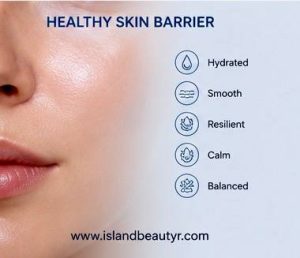
The Best Skincare Routine for Hyaluronic Acid for Skin Barrier Repair
Choosing the right ingredients is only part of the equation. How you layer them can make a significant difference in how well your skin barrier recovers.
If your skin feels dry, irritated, or sensitive, a simple routine is often more effective than using too many active ingredients.
Morning Routine
Step 1: Use a Gentle Cleanser
Start with a mild, fragrance-free cleanser that removes oil and impurities without stripping your skin.
Avoid cleansers containing high concentrations of sulfates or strong exfoliating acids while your barrier is healing.
Step 2: Apply Hyaluronic Acid
Apply Hyaluronic Acid for Skin Barrier Repair to slightly damp skin. Damp skin provides additional moisture that hyaluronic acid can bind to, improving hydration throughout the day.
A few drops are usually enough. Applying more products won’t necessarily produce better results.
Step 3: Use a Ceramide Moisturizer
Immediately follow with a moisturizer containing ceramides, cholesterol, and fatty acids.
This step seals hydration into the skin while reinforcing the barrier’s natural lipid matrix.
Step 4: Finish with Sunscreen
A damaged skin barrier is more vulnerable to UV radiation.
Use a broad-spectrum sunscreen with SPF 30 or higher every morning, even on cloudy days.
Skipping sunscreen can slow barrier recovery and increase inflammation.
Evening Routine
Evening is when your skin performs much of its natural repair work.
Keeping your nighttime routine simple allows those processes to function more effectively.
Your evening routine should include:
- Gentle cleanser
- Hyaluronic acid serum
- Barrier-repair moisturizer
- Optional occlusive balm if your skin is extremely dry
If you’re using retinoids or exfoliating acids, consider reducing their frequency until your skin barrier has recovered.
Sometimes, less really is more.
How Long Does Skin Barrier Repair Take?
One of the most common questions people ask after starting Hyaluronic Acid for Skin Barrier Repair is how quickly they can expect results.
The answer depends on the severity of the damage.
For mild dehydration caused by weather changes or occasional over-cleansing, noticeable improvement may appear within a few days.
If the barrier has been compromised by frequent exfoliation, strong retinoids, or chronic irritation, recovery often takes between two and six weeks with a consistent skincare routine.
More severe barrier damage associated with inflammatory skin conditions may require additional treatment under the guidance of a dermatologist.
Consistency is usually more important than buying additional products.
Frequently Asked Questions
Does hyaluronic acid repair the skin barrier?
Not directly. Hyaluronic Acid for Skin Barrier Repair supports the healing process by improving hydration and reducing transepidermal water loss, but it doesn’t replace the ceramides, cholesterol, and fatty acids needed to rebuild the barrier itself.
Is hyaluronic acid enough to repair a damaged skin barrier?
Usually not.
While it provides essential hydration, most dermatologists recommend combining hyaluronic acid with ceramides and a barrier-supporting moisturizer for optimal recovery.
Can I use hyaluronic acid every day?
Yes.
Most skin types tolerate hyaluronic acid well, making it suitable for both morning and evening use.
Daily application is often beneficial when repairing a compromised skin barrier.
Should I apply hyaluronic acid before or after moisturizer?
Apply hyaluronic acid first to slightly damp skin, then immediately follow with moisturizer.
This layering technique helps lock hydration into the skin and maximizes the benefits of Hyaluronic Acid for Skin Barrier Repair.
Is hyaluronic acid safe for sensitive skin?
In most cases, yes.
High-quality formulations without added fragrance or alcohol are generally well tolerated by sensitive skin.
If your skin is extremely reactive, introduce new products gradually and perform a patch test before full application.
Key Takeaways
If there’s one message to remember, it’s this:
Hyaluronic Acid for Skin Barrier Repair is a powerful supporting ingredient—not a complete solution.
It hydrates the skin, reduces discomfort, and creates the ideal environment for recovery, but true barrier repair depends on restoring the lipid matrix that holds skin cells together.
For the best results:
- Use hyaluronic acid on slightly damp skin.
- Follow with a ceramide-rich moisturizer.
- Avoid over-exfoliation while your barrier heals.
- Wear sunscreen daily.
- Be patient and consistent with your routine.
When used alongside barrier-replenishing ingredients, hyaluronic acid can help transform dry, irritated, and sensitive skin into a healthier, stronger, and more resilient complexion.
Conclusion
Healthy skin begins with a healthy barrier.
Although Hyaluronic Acid for Skin Barrier Repair has become one of the most popular skincare topics online, understanding what this ingredient can—and cannot—do is the key to getting real results.
Hyaluronic acid excels at restoring hydration, improving skin comfort, and supporting the skin’s natural healing process. However, it works best as part of a complete barrier-repair routine that also includes ceramides, cholesterol, fatty acids, and consistent sun protection.
Instead of looking for a single “miracle ingredient,” focus on building a routine that strengthens your skin over time.
Your skin barrier wasn’t damaged overnight, and it won’t recover overnight either. But with the right products and consistent care, healthier, calmer, and more resilient skin is an achievable goal.