
Closed Comedones: 9 Causes and Science-Backed Ways to Treat Them
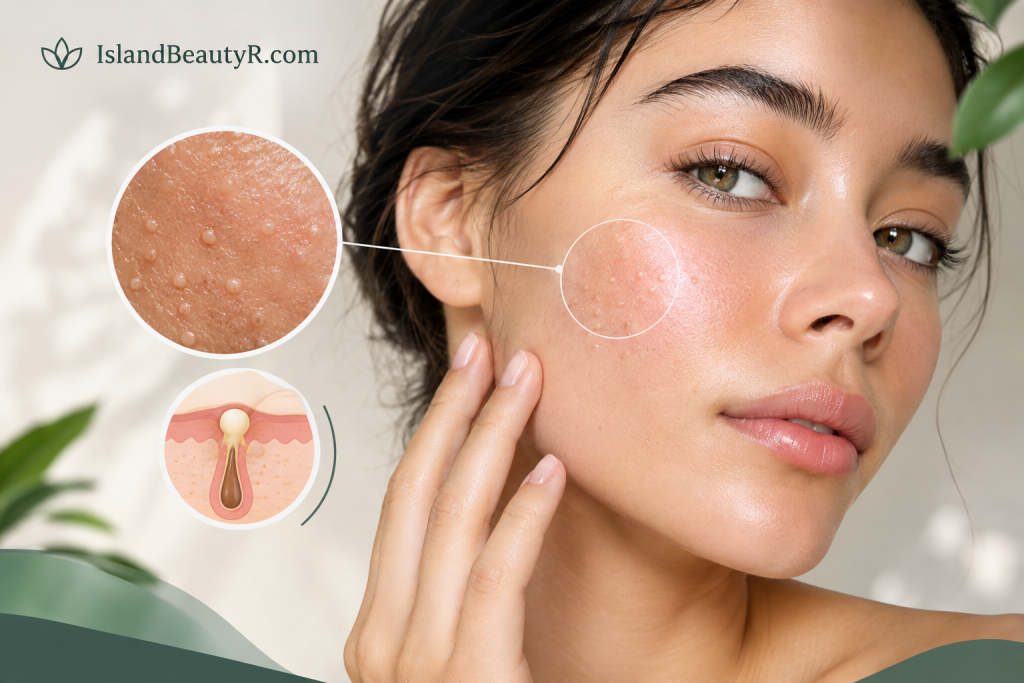
Small, flesh-colored bumps that make your skin look uneven can be surprisingly difficult to treat. If they do not look like typical pimples and rarely come to a visible “head,” you may be dealing with closed comedones.
Closed comedones are a type of non-inflammatory acne lesion that forms when a hair follicle becomes blocked by a mixture of sebum and abnormal buildup of dead skin cells. Because the follicular opening remains closed, the trapped material stays beneath the skin surface, creating a small white or skin-colored bump.
Unlike inflamed acne, closed comedones may not hurt, feel warm, or look dramatically red. That can make them easy to overlook—but when many develop together, they can create a rough, grainy texture that is especially noticeable under bright light or makeup.

The good news is that closed comedones are not simply a sign that your skin is “dirty.” They are primarily related to changes inside the follicle, including abnormal keratinization, sebum production, and other biological processes involved in acne formation.
This guide explains 9 common causes of closed comedones and the science-backed strategies that can help prevent and treat them without unnecessarily irritating your skin.
This is islandbeautyr.com, and I am Rasta Kafashan, the author of this website. I can help you better understand and become more aware of your skin, based on the most up-to-date scientific research. So, stay with us and follow islandbeautyr.com.
What Are Closed Comedones?
A closed comedone forms when the opening of a hair follicle becomes obstructed while remaining covered by the surface of the skin.
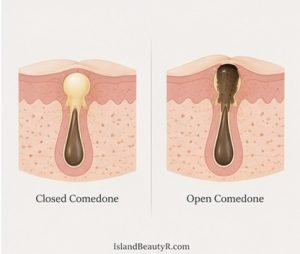
Think of the follicle as a tiny channel connecting the deeper skin structures to the surface. Normally, sebum and shed skin cells can move outward. When keratinized cells accumulate abnormally and mix with sebum, a plug can form.
If the follicular opening remains closed, the result is a closed comedone.
They commonly appear as:
- Small white or flesh-colored bumps
- Tiny raised areas with little or no redness
- Rough or uneven skin texture
- Clusters of bumps on the forehead, cheeks, chin, or jawline
- Persistent bumps that do not behave like typical pimples
Closed comedones are different from blackheads. A blackhead is an open comedone, meaning the follicular opening is exposed to air. The dark appearance is not simply trapped dirt.
Both types begin with follicular plugging, but their appearance differs according to whether the follicular opening is open or closed.
Why Do Closed Comedones Form?
The formation of closed comedones is more complicated than simply having “too much oil.”
Research on acne identifies several interacting processes, including abnormal follicular keratinization, increased or altered sebum production, microbial changes within the follicle, and inflammation.
The earliest visible problem may actually begin as a microcomedone, a microscopic follicular lesion that can develop before an obvious acne bump becomes visible.
This is why treating only the surface of the skin may not be enough. Effective management needs to address the processes that contribute to follicular blockage.
9 Causes of Closed Comedones
1. Abnormal Buildup of Dead Skin Cells
One of the most important causes of closed comedones is abnormal shedding of keratinocytes inside the follicle.
Your skin constantly produces and sheds cells. Under normal conditions, these cells separate and move toward the skin surface.
In acne-prone skin, however, follicular cells can become excessively sticky or accumulate abnormally. Instead of leaving the follicle efficiently, they combine with sebum and contribute to a compact plug.
This process is known as follicular hyperkeratinization.
That explains why simply washing your face more aggressively does not necessarily solve closed comedones. The problem begins inside the follicle rather than being caused by surface dirt alone.
What can help?
Ingredients that normalize follicular cell turnover can be useful. Topical retinoids are particularly important because they help prevent follicular plugging and new comedone formation.
2. Excess or Altered Sebum Production
Sebum is often blamed for acne, but it is important to understand that sebum itself is not “bad.”
Sebum contributes to the skin’s protective surface and has physiological functions. Problems arise when increased or altered sebum production interacts with abnormal follicular keratinization.
A follicle containing both excess sebum and retained keratinized material can become an ideal environment for a comedonal plug.
Hormonal signaling, especially androgen activity, can increase sebaceous gland activity. This is one reason acne and closed comedones can become more noticeable during periods of hormonal fluctuation.
What can help?
Avoid trying to eliminate all facial oil. Over-cleansing can irritate the skin without correcting the underlying follicular process.
A balanced routine with an appropriate cleanser, non-comedogenic moisturizer, sunscreen, and evidence-based acne treatment is generally more useful than repeatedly stripping the skin.
3. Hormonal Changes
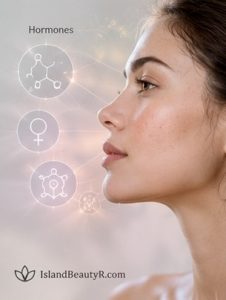
Hormones can influence sebaceous gland activity and therefore contribute to the development of closed comedones.
Hormonal changes can also influence other patterns of acne and skin behavior, which is why understanding hormonal skin health can be useful when breakouts follow a recurring pattern.
Androgens stimulate sebaceous glands, increasing sebum production. This is one reason acne often appears around puberty and why some adults experience recurrent acne during hormonal fluctuations.
In some women, acne may become more noticeable around the menstrual cycle or alongside other signs of hormonal imbalance.
However, having closed comedones does not automatically mean that you have a hormonal disorder.
Hormones are one potential contributor among several.
When should you investigate further?
If persistent acne suddenly develops in adulthood, becomes significantly worse around the jawline, or occurs alongside symptoms such as irregular menstrual cycles or increased facial hair, discussing the pattern with a healthcare professional may be appropriate.
4. Comedogenic or Occlusive Products
Some skincare, haircare, and cosmetic products can contribute to acne in susceptible individuals.
The issue is not necessarily that a particular ingredient is universally “pore-clogging.” Skin responses vary, and product formulation matters.
Heavy products may create an occlusive environment, while certain cosmetic or haircare products can contribute to follicular blockage when they repeatedly contact acne-prone areas.
This can be particularly relevant when bumps appear along:
- The forehead
- Hairline
- Temples
- Cheeks where hair products touch the skin
- Areas repeatedly covered by makeup
What can help?
Look for products labeled non-comedogenic when possible, especially if you are prone to acne.
If a new product is followed by a sudden increase in tiny bumps, consider whether the timing and distribution suggest a product-related trigger.
5. Over-Exfoliation and Skin Irritation
It may seem logical that more exfoliation should produce fewer clogged pores.
But more is not always better.
Using multiple exfoliating acids, scrubs, cleansing brushes, strong acne products, and frequent treatments can irritate the skin. Irritation does not directly mean that every bump is a closed comedone, but it can make acne-prone skin harder to manage.
Aggressive scrubbing can also increase irritation and make texture appear worse. Understanding how irritation affects the skin barrier can also help you build a more balanced acne routine.
The goal is not to remove as much skin as possible. The goal is to regulate follicular turnover while maintaining a tolerable skincare routine.
A better strategy
Introduce one active treatment at a time and give your skin enough time to adapt.
If your routine causes persistent burning, significant peeling, or increasing redness, the problem may be excessive irritation rather than insufficient exfoliation.
6. Using Too Many Skincare Products
A complicated routine can make it difficult to identify what is actually helping.
Layering multiple acids, retinoids, acne treatments, masks, scrubs, and active serums can increase irritation without necessarily producing faster results.
This is especially relevant when someone sees tiny bumps and responds by adding more products.
Instead, a structured routine is usually easier to evaluate:
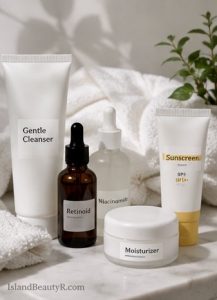
Cleanse → treat → moisturize → protect
The exact products depend on your skin and the severity of your acne, but simplicity can make troubleshooting much easier.
7. Genetics and Acne-Prone Skin
Some people naturally have a greater tendency toward acne because of genetic and biological factors.
Genetics can influence sebaceous gland activity, follicular keratinization, inflammatory responses, and how an individual’s skin responds to hormonal signals.
This means that two people can follow almost identical skincare routines while experiencing very different numbers of closed comedones.
If several close family members have struggled with persistent acne, genetics may be part of the picture.
That does not mean acne cannot be treated. It simply means that skincare habits are not the entire explanation.
8. Certain Medications and Hormonal Treatments
Some medications can contribute to acneiform eruptions or worsen acne in susceptible individuals.
Because medication-related breakouts can resemble ordinary acne, the timing can be an important clue.
If you notice a persistent increase in bumps after starting a new medication or changing a hormonal treatment, do not stop prescribed medication on your own.
Instead, discuss the change with the healthcare professional who prescribed it.
The cause may be medication-related, hormonal, or simply coincidental, and identifying the pattern is more useful than guessing.
9. Your “Acne” May Not Actually Be Closed Comedones
Not every cluster of tiny bumps is closed comedones.
Before changing your entire skincare routine, it is also worth considering whether you have correctly identified your skin type and the actual cause of the bumps.
Several conditions can resemble them, including milia, folliculitis, irritant reactions, and other forms of acne.
This distinction matters because treatment is not identical.
For example, folliculitis can sometimes produce many similar-looking small bumps, while milia are tiny keratin-filled cysts rather than typical acne comedones.
A useful clue
Closed comedones usually have a relatively uniform, flesh-colored or whitish appearance and are associated with clogged follicles.
If the bumps are intensely itchy, suddenly widespread, painful, unusually inflamed, or resistant to appropriate acne treatment, professional evaluation can help determine whether you are treating the correct condition.
How to Treat Closed Comedones: 9 Science-Backed Strategies
1. Use a Topical Retinoid
Topical retinoids are among the most important treatments for comedonal acne.
They help normalize follicular keratinization and reduce the formation of clogged pores. Adapalene is an over-the-counter retinoid in some countries, while tretinoin and other retinoids may require a prescription depending on where you live.
Because retinoids can initially cause dryness or irritation, starting gradually may improve tolerability.
Do not assume that applying more will make closed comedones disappear faster.
Consistency matters more than excessive application.
Important: topical retinoids are generally avoided during pregnancy unless a qualified healthcare professional specifically advises otherwise.
2. Consider Salicylic Acid
Salicylic acid is a beta-hydroxy acid that can help exfoliate within the pore environment.
It is particularly useful for clogged pores, whiteheads, and blackheads.
For people with mild closed comedones, a salicylic acid cleanser or leave-on product may be a useful part of a broader routine.
However, concentration and frequency matter.
If your skin becomes dry, burning, or irritated, reducing frequency is usually more sensible than increasing it.
3. Consider Benzoyl Peroxide When Inflammatory Acne Is Also Present
Benzoyl peroxide is best known for its effect on acne-associated bacteria and inflammatory lesions.
It is not necessarily the first ingredient you would choose if your only concern is purely comedonal acne.
However, if your closed comedones coexist with red pimples or inflammatory acne, benzoyl peroxide may have a useful role in a broader treatment strategy.
The AAD recommends benzoyl peroxide as one of the evidence-supported topical acne treatments.
Starting with a lower concentration can help reduce unnecessary irritation.
4. Consider Azelaic Acid
Azelaic acid is another evidence-supported acne treatment.
It has multiple biological effects and may be useful when acne occurs alongside post-inflammatory discoloration.
For someone dealing with both clogged pores and lingering marks, azelaic acid can be an appealing option to discuss with a dermatologist.
It may be particularly useful when you want an acne treatment that can also address uneven pigmentation.
5. Choose a Gentle, Non-Comedogenic Cleanser
Cleansing removes surface oil, sunscreen, makeup, and environmental debris.
But cleanser cannot physically “pull out” every closed comedone.
A gentle cleanser used consistently is generally more useful than aggressive scrubbing.
Clinical guidelines recommend using a gentle, non-alkaline cleansing product for acne-prone skin.
6. Moisturize Even If Your Skin Is Oily
Oily skin does not mean that moisturizer should automatically be skipped.
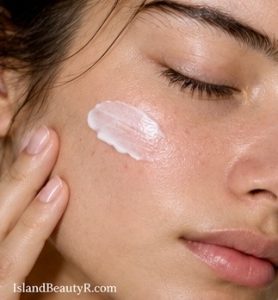
However, using too much moisturizer or choosing an unsuitable formula can create a different set of skincare problems.
Acne treatments can cause dryness and irritation, and an uncomfortable skin barrier can make it harder to maintain a consistent treatment routine.
Look for a moisturizer that feels comfortable and is appropriate for acne-prone skin.
The goal is not to make the skin completely oil-free.
Healthy skin still needs an appropriate balance of water, lipids, and barrier function.
7. Avoid Picking and DIY Extraction
Trying to squeeze closed comedones at home can be tempting because the bumps feel like they should be easy to remove.
But closed comedones do not always have an accessible opening.
Repeated squeezing can traumatize the surrounding skin and potentially increase inflammation or pigmentation.
If stubborn comedones do not respond to appropriate skincare, professional extraction may be safer than repeated home manipulation.
8. Give Your Treatment Enough Time
One of the biggest mistakes in acne skincare is changing products too quickly.
A treatment may require several weeks before meaningful improvement becomes apparent.
The AAD advises giving acne treatment time to work and notes that stubborn whiteheads and blackheads may require approximately six to eight weeks of consistent treatment before deciding whether a change is needed.
This is particularly important with closed comedones, because the goal is not only to clear existing plugs but also to reduce the formation of new ones.
9. See a Dermatologist When the Pattern Does Not Improve
Persistent, closed comedones may need a more personalized approach.
A dermatologist can determine whether the bumps are actually comedonal acne and can prescribe stronger or combination treatments when appropriate.
Professional assessment becomes especially important when:
- Acne is widespread or severe
- Painful inflammatory lesions are appearing
- You are developing scars
- Over-the-counter treatments have failed
- The bumps are unusually itchy
- The diagnosis is uncertain
- Acne suddenly becomes significantly worse
For persistent or severe acne, professional treatment can prevent months of ineffective experimentation.
A Simple Routine for Closed Comedones
You do not need ten acne products to manage closed comedones.
A simple framework may look like this:
Morning
1. Gentle cleanser
Clean the skin without aggressive scrubbing.
2. Optional acne treatment
Depending on your skin and treatment plan, this could include an appropriate acne active.
3. Lightweight moisturizer
Choose a comfortable, non-comedogenic formula.
4. Broad-spectrum sunscreen
Daily sunscreen helps protect against UV-related skin damage and is especially important if you are using products that can increase irritation or sensitivity.
Evening
1. Gentle cleanser
Remove sunscreen, makeup, oil, and environmental residue.
2. Topical retinoid or another evidence-based acne treatment
Use the treatment appropriate for your skin and medical situation.
3. Moisturizer
Support comfort and reduce excessive dryness.
The exact combination should be adjusted according to your skin’s tolerance and whether your acne is primarily comedonal or also inflammatory.
What Not to Do for Closed Comedones
Some popular acne advice can actually make the situation worse.
Avoid relying on:
Aggressive facial scrubs
Physical abrasion does not solve the biological cause of follicular plugging.
Squeezing every bump
Closed lesions often do not have an easy surface opening.
Using multiple acids at once
More exfoliations do not automatically mean faster clearing.
Washing your face repeatedly
Over-cleansing can increase irritation.
Changing products every few days
Acne treatments need time.
Assuming every tiny bump is acne
Milia, folliculitis, and other conditions can look similar.
How Long Do Closed Comedones Take to Clear?
There is no single timeline because the answer depends on how many lesions are present, how long they have been developing, the treatment being used, and individual skin biology.
In general, acne treatment should be evaluated over weeks rather than days.
A treatment that appears ineffective after three or four days may simply not have had enough time to influence the follicular cycle.
Consistency is therefore one of the most important parts of treating closed comedones.
If your routine also includes barrier-supportive skincare, understanding the typical skin barrier recovery timeline can help you avoid changing products too quickly.
If there is no meaningful improvement after an appropriate period of consistent treatment—or if the condition is worsening—a dermatologist can reassess the diagnosis and treatment strategy.
Can Closed Comedones Turn into Pimples?
Yes.
A comedone can remain non-inflammatory, but a blocked follicle can also become inflamed as acne progresses.
This is one reason treating comedonal acne early can be useful.
The biological processes involved in acne are interconnected: follicular plugging, sebum, microbial activity, and inflammation can influence one another.
Therefore, a tiny flesh-colored bump should not automatically be considered harmless or permanently static.
Are Closed Comedones Caused by Dirty Skin?
No.
This is one of the most important myths to eliminate.
Closed comedones develop primarily because of processes occurring within the pilosebaceous unit, particularly abnormal follicular keratinization and interaction with sebum.
Washing harder does not necessarily remove the underlying follicular plug.
In fact, excessive cleansing and scrubbing can irritate acne-prone skin.
Clean skin and acne-free skin are not the same thing.
Final Takeaway
Closed comedones are small, blocked follicles that appear as white or flesh-colored bumps beneath the skin surface. They are not simply caused by poor hygiene or having “dirty pores.”
Their development is influenced by several biological and environmental factors, including abnormal follicular keratinization, sebum production, hormonal signaling, genetics, product exposure, irritation, and other acne-related processes.
The most useful approach is usually not to attack the skin with more and more exfoliation. Instead, focus on a consistent routine built around evidence-based acne treatments.
Topical retinoids are particularly important for comedonal acne because they help normalize follicular turnover and prevent pore clogging. Salicylic acid, benzoyl peroxide, and azelaic acid can also have roles depending on the type and severity of acne.
Most importantly, give treatments enough time to work, avoid aggressive picking, and reconsider the diagnosis if the bumps do not behave like typical acne.
When closed comedones persist despite a consistent routine, professional evaluation can help determine whether you need a different treatment—or whether the bumps are actually another skin condition.
Frequently Asked Questions
1. What are closed comedones?
Closed comedones are clogged hair follicles whose openings remain covered by the skin. They usually appear as small white or flesh-colored bumps and are considered a form of non-inflammatory acne.
2. What causes closed comedones?
Common contributing factors include abnormal follicular keratinization, sebum production, hormonal influences, genetics, certain products, irritation, and other acne-related biological processes.
3. What is the best ingredient for closed comedones?
Topical retinoids are among the most important evidence-based treatments for comedonal acne because they help normalize follicular turnover and reduce clogging. Salicylic acid is another useful option for clogged pores.
4. Can salicylic acid remove closed comedones?
Salicylic acid can help exfoliate and unclog pores, making it useful for comedonal acne. However, results depend on concentration, frequency, skin tolerance, and how extensive the acne is.
5. Should I squeeze closed comedones?
It is better not to squeeze them yourself. Because the follicular opening is closed, squeezing can traumatize the surrounding skin and increase inflammation or discoloration.
6. How long does it take for closed comedones to improve?
Acne treatments generally require several weeks of consistent use. The AAD notes that stubborn whiteheads and blackheads may require around six to eight weeks before treatment response can be properly assessed.
7. Can moisturizer cause closed comedones?
Some products may contribute to breakouts in acne-prone individuals, but it is inaccurate to assume that every moisturizer causes clogged pores. Choosing a lightweight, non-comedogenic product can reduce the likelihood of product-related problems.
8. Why do I suddenly have lots of tiny bumps?
A sudden increase in tiny bumps can have several explanations, including acne, product-related breakouts, irritation, hormonal changes, or conditions that resemble acne. If the bumps are itchy, unusual, or persistent, professional assessment can help.
9. Are closed comedones the same as milia?
No. They can look similar, but they are different conditions. Closed comedones are clogged follicles associated with acne, while milia are small keratin-filled cysts.
10. Can closed comedones become inflamed acne?
Yes. A blocked follicle can become inflamed, which may result in a red papule or another inflammatory acne lesion.
Medical Disclaimer
This article is intended for educational purposes only and does not replace professional medical advice, diagnosis, or treatment. If your acne is severe, painful, persistent, scarring, suddenly worsening, or difficult to diagnose, consult a qualified dermatologist or healthcare professional.