

The Hidden pH Trigger Behind Acne: How a 0.5 Shift in Skin Acidity Disrupts Your Barrier
The 0.5 Shift That Changes Everything
For decades, acne has been blamed on excess oil, clogged pores, hormones, or bacteria alone. But emerging dermatological research reveals a more fundamental driver: skin pH and acne are biologically interconnected in ways most routines ignore.
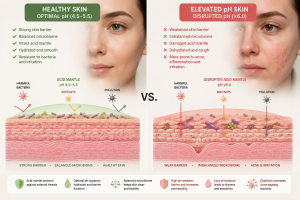
Healthy skin maintains a slightly acidic surface, typically between 4.5 and 5.5. This acidity forms the acid mantle — a biochemical shield that regulates enzymes, controls microbial growth, and preserves barrier lipids. When this balance shifts upward by as little as 0.5 pH units, the protective system begins to weaken. That seemingly small rise — from 5.5 to 6.0 — can alter lipid organization, disrupt antimicrobial peptides, and increase transepidermal water loss.
This is where skin pH and acne begin to intersect powerfully.
A higher pH environment favors the proliferation of acne-associated bacteria, increases inflammatory signaling, and interferes with natural exfoliation. The result? Microcomedones form more easily, inflammation escalates faster, and the skin struggles to repair itself. Instead of asking “How do I dry this pimple?”, a more strategic question is: “Is my pH environment fueling this breakout?”
Understanding skin pH and acne reframes acne not simply as clogged pores — but as a biochemical imbalance within the barrier ecosystem.
This is islandbeautyr.com, and I am rasta kafashan, author of this website. I can help you better understand and be aware of your skin based on the most up-to-date scientific research. So, stay with us and follow islandbeautyr.com.
The Acid Mantle: Your First Line of Defense
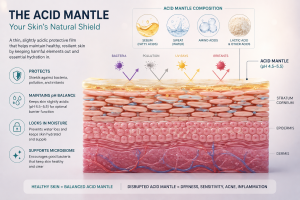
The acid mantle is a thin film composed of sebum, sweat components, fatty acids, and amino acids. Its acidic nature performs several critical roles:
- Inhibits growth of pathogenic bacteria
- Optimizes lipid-processing enzymes
- Maintains corneocyte cohesion
- Regulates desquamation
When discussing skin pH and acne, it is essential to understand that enzyme systems responsible for shedding dead skin cells operate best in an acidic range. If pH rises, desquamation becomes irregular. Corneocytes accumulate inside follicles, leading to blockage — the earliest stage of acne formation.
Disruption of this system means barrier lipids are not properly organized. Gaps appear in the stratum corneum, irritants penetrate more easily, and inflammatory cascades begin. The relationship between skin pH and acne is therefore not superficial — it is structural and biochemical.
How a 0.5 Increase Alters the Microbiome
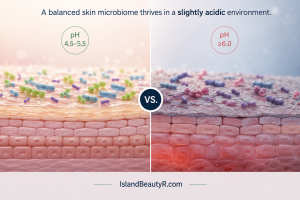
The skin microbiome thrives in mildly acidic conditions. Beneficial microbes help suppress overgrowth of acne-associated strains. However, even a slight alkalinization shifts this balance.
Research shows that when pH increases:
- Antimicrobial peptide activity decreases
- Bacterial adhesion to follicles increases
- Inflammatory mediators rise
- Sebum breakdown becomes more irritating
This microbiological imbalance is a core mechanism linking skin pH and acne. Acne is not caused by bacteria alone; it is triggered when environmental conditions allow inflammatory strains to dominate.
In short: change the pH, change the ecosystem.
Cleansers: The 30-Second Disruptor
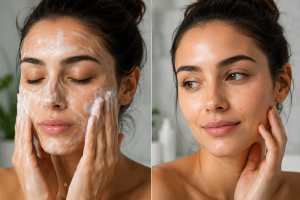
Many foaming cleansers have a pH between 7 and 9. When applied, they temporarily neutralize the skin’s acidity. Although the skin can self-correct, repeated exposure prevents full recovery.
Within seconds, alkaline cleansing can:
- Increase surface pH
- Disrupt lipid bilayers
- Elevate water loss
- Reduce barrier cohesion
If this occurs twice daily, the cumulative effect strengthens the connection between skin pH and acne. Over time, the barrier remains in a semi-compromised state, primed for inflammation and breakouts.
A balanced cleanser formulated near pH 5.5 significantly reduces this disruption.
Sebum Oxidation and Follicular Inflammation
Sebum itself is not the enemy. In a healthy acidic environment, sebum components contribute to barrier protection. But when pH rises, lipid oxidation increases.
Oxidized lipids:
- Trigger inflammatory cytokines
- Increase follicular hyperkeratinization
- Contribute to comedone stability
This biochemical shift further strengthens the mechanistic link between skin pH and acne. Instead of merely producing “too much oil,” the skin is producing oil in a destabilized chemical environment.
Enzymes, Exfoliation, and Keratin Plug Formation
Desquamation depends on protease enzymes that dissolve bonds between dead cells. These enzymes are pH sensitive. At optimal acidity, shedding is controlled and uniform.
When pH rises:
- Enzyme efficiency declines
- Dead cells accumulate
- Follicles narrow
- Microcomedones develop
This is a pivotal moment in the skin pH and acne pathway. Before visible inflammation appears, microscopic plugs have already formed due to altered enzyme kinetics.
Barrier Damage and Chronic Inflammation
An elevated pH weakens ceramide organization and tight junction proteins. Barrier permeability increases, allowing irritants and microbial fragments to penetrate deeper layers.
The immune system responds with:
- Increased IL-1 signaling
- Elevated TNF-alpha
- Local vasodilation
- Redness and swelling
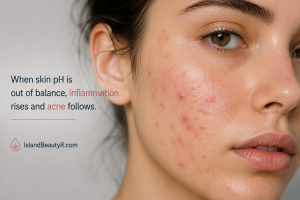
Thus, skin pH and acne converge again at the level of immune activation. Acne lesions are not just clogged pores — they are inflammatory events triggered by barrier dysregulation.
The Recovery Window: Hours Matter
After alkaline exposure, skin may require 4–24 hours to restore normal acidity. During this period:
- Bacterial growth potential increases
- Enzymatic imbalance persists
- Lipid synthesis is disrupted
If disruption occurs again before full recovery, the skin never re-establishes equilibrium. Chronic imbalance reinforces the cycle linking skin pH and acne.
Consistency in maintaining acidic balance is more important than occasional treatment products.
Practical Strategies to Stabilize Skin pH
To reduce the impact of skin pH and acne, consider evidence-based adjustments:
- Use pH-balanced cleansers (4.5–5.5)
- Avoid over-exfoliation
- Limit high-alkaline soaps
- Incorporate barrier-supportive ingredients (ceramides, niacinamide)
- Avoid frequent product switching
Restoring pH stability does not produce overnight miracles. Instead, it gradually reduces inflammatory triggers and improves resilience.

Why Treating Oil Alone Fails
Drying agents may temporarily reduce shine, but they often increase pH and barrier damage. This paradox explains why aggressive acne treatments sometimes worsen sensitivity and breakouts.
Without addressing skin pH and acne, treatments focus on symptoms rather than biological drivers. Sustainable improvement depends on rebuilding an acidic, stable environment.
The Bigger Picture: Acne as a Barrier Disorder
Modern dermatology increasingly recognizes acne as partly a barrier dysfunction disorder. While hormones and genetics play roles, environmental disruption magnifies severity.
The recurring theme in current research is clear: skin pH and acne are deeply intertwined through microbiology, enzymology, lipid chemistry, and immunology.
A 0.5 pH shift is not cosmetic trivia — it is a biochemical tipping point.
Conclusion: Small Numbers, Powerful Impact
Acne does not begin with a visible pimple. It begins with microscopic imbalance. A subtle increase in pH destabilizes enzymes, lipids, microbes, and immune responses simultaneously.
By understanding the science behind skin pH and acne, skincare becomes strategic rather than reactive. Supporting the acid mantle strengthens barrier integrity, stabilizes the microbiome, and reduces inflammatory triggers.
In barrier biology, half a unit can change everything.