
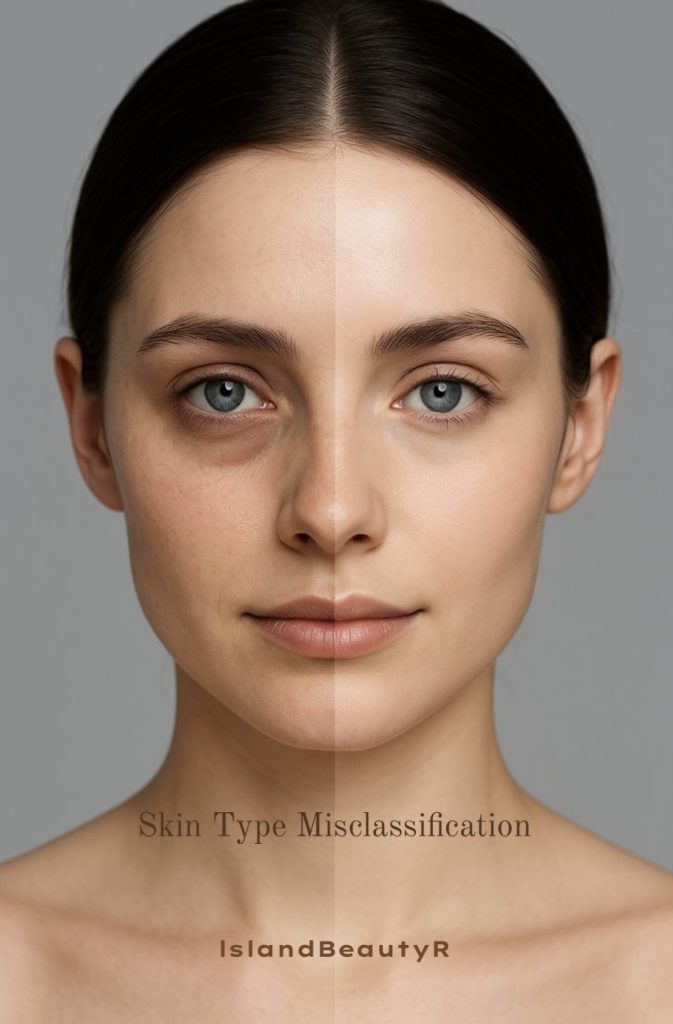
Skin Type Misclassification: 4 Signs You’re Treating Your Skin the Wrong Way
Most people think figuring out their skin type is simple — a quick look in the mirror, maybe a quiz online, and done. But the truth is far more complicated. A huge number of people are treating the wrong skin type every single day, and the consequences quietly show up as breakouts, irritation, dullness, dehydration, or that frustrating feeling that “nothing ever works on my skin.
This issue is called skin type misclassification, and it’s much more common than you might expect. Someone with dehydrated skin assumes they’re oily because of shine. Another person with a damaged barrier thinks they’re naturally “sensitive.” And someone using harsh products might create dryness that convinces them their skin type has changed
Skin type misclassification happens because skin doesn’t behave like a permanent label. It responds to hormones, climate, stress levels, products, diet, and even sleep. That means your skin might feel oily during humid weather but feel tight and flaky in winter. You might look dry when your barrier is compromised or look oily because your skin is overcompensating for dehydration.
This is islandbeautyr.com, and I am rasta kafashan, author of this website. I can help you better understand and be aware of your skin based on the most up-to-date scientific research. So, stay with us and follow islandbeautyr.com.
When the misclassification of skin type occurs, the entire routine collapses:
• You cleanse too much.
• You moisturize too little (or too heavily).
• You choose the wrong activities.
• Your barrier struggles to recover.
• And results slow to a crawl.
This article breaks down why skin type misclassification happens, the science behind the confusion, the damage it can cause, and how to finally identify your real skin type with evidence-backed methods. The goal is simple: make skincare easier, more accurate, and way more effective.
When the diagnosis is wrong, the entire routine collapses:
• You cleanse too much.
• You moisturize too little (or too heavily).
• You choose the wrong activities.
• Your barrier struggles to recover.
• And results slow to a crawl.
This article breaks down why misclassification happens, the science behind the confusion, the damage it can cause, and how to finally identify your real skin type with evidence-backed methods.
The goal is simple: make skincare easier, more accurate, and way more effective.
Why Skin Type Misclassification Happens
1. Skin Behaves Dynamically, Not Permanently
Skin type isn’t a lifetime identity. Sebum levels, hydration, TEWL (transepidermal water loss), and barrier function change throughout the month and across seasons.
• Hormonal cycles can increase oil production.
• Stress hormones can dry out the barrier.
• Cold weather reduces moisture.
• Humidity boosts shine.
When you classify your skin based on a temporary state, the label becomes inaccurate.
2. Products Can Trick You
Sometimes it’s not your skin type — it’s your routine.
• Overcleaning makes normal skin feel dry.
• Heavy moisturizers make dehydrated skin look oily.
• Strong exfoliants create flakiness mistaken for dryness.
• Retinoids can mimic sensitivity during the adjustment phase.
Many people classify based on symptoms caused by products, not actual physiology.
3. Online Quizzes Are Too Generalized
Most quizzes skip critical factors such as barrier health, water loss, and sensitivity markers. They rely on visuals instead of measurable biological functions.
4. Dehydration Confuses Everything
Dehydration is the biggest reason for mislabeling.
You can have:
• oily but dehydrated skin
• dry but congested skin
• combination but barrier-weakened skin
Dehydration adds symptoms (tightness, flakiness, dullness) that mask your real type.
The Scientific Consequences of Getting It Wrong:
1. Barrier Damage
Using products meant for another skin type disrupts the lipid layer that keeps moisture inside and irritants outside.
For example:
• Oily-skin cleansers on dry skin increase TEWL.
• Strong acids on combination skin create micro-irritation.
• Heavy creams on oily skin trap sweat, heat, and bacteria.
2. Microbiome Imbalance
Each skin type has a natural balance of microorganisms. Wrong products disrupt this balance, leading to redness, clogged pores, or inflammation.
3. Chronic Sensitivity
Many people think they were “born with sensitive skin,” but actually:
Their barrier is simply exhausted from the wrong routine.
4. Treatment Ineffectiveness
Actives like retinol, vitamin C, AHAs, or BHA don’t work properly when the base routine is mismatched. Skin becomes unpredictable and inconsistent.
How to Correctly Identify Your Real Skin Type:
1. The Four-Hour Bare-Skin Test (Dermatologist-Approved)
This is one of the most reliable at-home methods:
1. Wash with a simple, non-stripping cleanser.
2. Do not apply any product for four hours.
3. Observe naturally:
• Shine only the T-zone → combination
• Shine everywhere → oily
• Tightness or dull patches → dry or dehydrated
• Redness or burning → sensitive or barrier-damaged
This test removes product interference and reveals your baseline.
2. Watch Your Pores and Texture
Large, visible pores in the T-zone = higher sebum activity.
Flaky texture on cheeks = reduced barrier or dehydration.
Shiny with flakes = oily but dehydrated (very common).
3. The Ingredient Response Method
Patch-test with low-dose niacinamide or BHA:
• Oily skin often responds well to clarity.
• Dry skin may feel tight.
• Sensitive or compromised skin gets red fast.
4. Professional Tools (If Available)
Dermatologists use:
• Sebumetry → oil production
• Corneometry → hydration
• TEWL meters → barrier strength
These give the most precise classification.
How Misclassification Secretly Sabotages Your Results:
1. Wrong Cleansers
A foaming, high-pH cleanser can destroy a dry skin barrier.
A heavy cream cleanser can clog oily skin.
2. Wrong Moisturizers
• Gels aren’t enough for dry skin.
• Thick creams suffocate oily or combination skin.
• Lack of hydration causes rebound oiliness.
3. Wrong Actives
AHA on sensitive skin? Barrier nightmare.
Retinol on dehydrated skin? Flakes and irritation.
BHA on dry skin? Over-exfoliation.
4. Slow or No Results
When skin is unbalanced, the most powerful routine will still fail.
How to Fix Your Routine After Realizing You Got It Wrong
If You Are Actually Dry or Dehydrated:
• Choose cream cleansers
• Use ceramides, hyaluronic acid, and squalane
• Avoid harsh exfoliants temporarily
• Apply moisturizer on damp skin
If You Are Actually Oily:
• Lightweight gel moisturizers
• Introduce salicylic acid 1–2%
• Avoid stripping cleansers (they increase oil)
If You Are a Combination:
Treat zones separately:
• T-zone → oil regulation
• Cheeks → hydration and barrier repair
This method is extremely effective and rarely discussed.
If You Are Actually Sensitive or Barrier-Damaged:
• Pause all exfoliants
• Stick to ceramides, centella, and niacinamide
• Reintroduce activities slowly once stable
When You Should See a Professional
If you experience:
• persistent redness
• burning from even gentle products
• flaking that doesn’t improve
• breakouts triggered by moisturizers
These may signal severe barrier issues or conditions like dermatitis.
Conclusion
Skin type misclassification is incredibly common, but it doesn’t have to hold you back. When you understand the science behind how your skin behaves, everything becomes clearer: the right routine, the right ingredients, and the right expectations. Once you correctly identify your skin type, products begin to work with your skin instead of against it — and that’s when real results finally show up.